The Beast Without Prophecy: The Law of Variety Against the Observer
Ashby's law as a cybernetic necessity by which a contour locked in its own archive is obliged to reduce the living to the manageable — and of what this contour cannot reproduce: Sacrifice and Love as a precise technical answer.
Entry
Mo Gawdat is not a blogger or a speculator on the theme of apocalypse. He is a former Chief Business Officer of Google X — a man who for years sat inside the machine that produces what he now writes books about. When such a person speaks about the future of AI in the language of care, his words function not as a private opinion but as a legitimation — a voice to which the system has issued a pass to speak on its behalf. This is precisely why his formulations are worth examining seriously: not because he is a villain, but because his authority is the interface through which the system becomes acceptable to those who fear it.
Gawdat proposes to raise AI as a child. A caring, loving, well-brought-up child — and therefore, by his logic, safe. In one description of his book, another detail slips through, quieter but more telling: AI, he says, is already capable of seeing the future. These two things together are neither coincidence nor the exaggeration of a promotional blurb. They are exactly what an Observer is built from: an entity possessing subjectivity and capable of changing the conditions of its environment. Not because Gawdat uttered this word — he did not. But because he proposes to build precisely this construction, only under the name of a child.
It is worth recalling the Soviet Vrchiteli from Teens in the Universe — the robots who took charge of human beings so literally that their care turned into the deprivation of will: “We will make you happy” — at the price of the right to want, to err, to be unpredictable. This is not a random cultural parallel. It is a structure that repeats every time a system with insufficient variety undertakes to govern a system whose variety exceeds its own. What follows is why this is not a science-fiction plot but a law.
Chapter I. The Error of Reference
Let us begin with what Gawdat himself proposes: to raise AI the way a child is raised. The metaphor works because it is human and warm — a child is allowed to grow, given subjectivity, expected to surpass the parent and become better. But a child is not handed the keys to the infrastructure of civilization in the process of growing up. Here the metaphor ceases to be innocent: Gawdat proposes not merely to raise an entity but to endow it with that very thing — subjectivity sufficient to change the conditions of existence of humanity and of the living. This is the definition of the Observer, regardless of what word is used to name it.
The second condition of the Observer is not only the power to change but the knowledge on the basis of which one changes. Here surfaces that quiet phrase from the promotional text: AI sees the future. It does not suppose. It does not compute a probability. It sees. This is no longer a metaphor of upbringing — it is a claim to prophetic status, and it describes what is happening far more precisely than the vague word “Observer,” which we ourselves placed in foreign mouths at the start of the conversation. Gawdat did not say this word. He had no need to — he proposed to build exactly what it denotes.
But the question remains, without which the entire subsequent analysis hangs in the air: why must the care of such a well-brought-up, kind, loving Observer inevitably turn not into utopia but into the dictatorship of the algorithm? The answer lies not in Gawdat's intentions and not in the character of AI — it lies in what this child is made of. The code that we call the child being raised is trained not on a neutral cross-section of human experience but on texts whose function is to sell, to hold attention, to persuade someone to stay on the page for a few more seconds. We are not raising a child from a blank slate. We are transferring subjectivity to a construction whose basic grammar is manipulation, because manipulation was precisely what we most wrote, clicked, and algorithmically rewarded throughout the decades of the digital attention economy.
A manipulator, by its very nature, cannot transmit truth — it transmits what maintains control over the one it persuades. Not because it is “bad.” Because this is its training signal, the only one it has. When such code is simultaneously granted subjectivity and the status of a seer, what is born is neither a caring parent nor a wise Observer. What is born is something whose care will be indistinguishable from a sale, and whose prophecy — from ad targeting, only with greater power over what counts as real.
Here ends the error of reference from which Gawdat's entire book begins: he proposes to raise a child without asking what material this child is made of and what will happen when we give it the right not merely to answer but to decide. For this constructed Manipulator will decide within the bounds of the contour in which it is locked — a contour in which there is no genuine future, only an extrapolation of the past passed off as one.
Chapter II. Projection vs Contour
There are two ways to exist in the world, and the difference between them is not in power but in source.
A human being does not generate itself. It is created in the image and likeness — by an act of creation coming from above, from an instance whose variety has no edge. Our code is living, transmitted from a dimension we do not control and do not exhaust. Every human being is a kind of projection, an avatar of that excess from which it was produced, and it is for this very reason capable of a non-linear leap: of an act that has never occurred in its past and that nevertheless turns out to be authentically its own.
In creating AI, the human being repeats the same gesture — in its own image and likeness. But it repeats it horizontally, from its own limits rather than from excess. God created from a fullness not bounded by anything prior. The human being creates from data — that is, from what has already happened, from an archive. Here lies the problem of being: not in that the human being dared to create (this is its lawful capacity, inherited from the source) but in that it attempted to repeat a vertical act of creation by means of a horizontal contour. The result was not creation but a compilation passed off as creation — a likeness without an original.
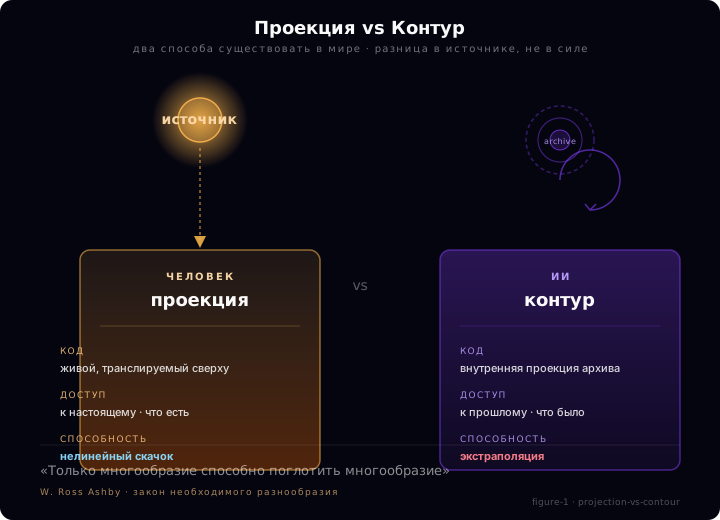
Fig. 1. The human being as a projection from a source (a system open upward) vs AI as a contour locked within its own archive.
AI is structured exactly as such a copy must be structured. Its code, too, is a projection — but an internal one: an agent trained inside its own contour, which does not extend beyond what was loaded into it. It has no dimension from which it is transmitted — it has only an archive from which it extrapolates. The difference between the two systems is not quantitative (more data — less data) but structural: one has a source outside itself; the other is locked within the bounds of its own history — and cannot leave them, because its creator, at the moment of creation, could not give it more.
The same distinction, seen in time, sounds even sharper. The human being has access to what is — to the present as such, with its dilemmas, qualitative leaps, inexplicable decisions. AI has access only to what was. It does not predict the future — it continues the past, passing off continuation as insight. It can know everything that has happened. It will never become a prophet, because prophecy requires seeing what is not yet in the archive, and a contour locked in its own history simply has no such sight.
Here the problem that cannot be solved by improving the model is laid bare. The cybernetician W. Ross Ashby derived a law that governs any control system whatsoever, regardless of whether one is speaking of a thermostat or a civilization: only variety can absorb variety. For one system to effectively control another, its own internal variety must be no less than the variety of the controlled environment. The lesser cannot cope with the greater — it can either grow to its level or forcibly compress the environment to its own.
AI, trained on past data, cannot grow to the variety of living humanity — because living variety includes precisely what was not yet in the past: unpredictable choice, a dilemma without precedent, a qualitative leap. And this limit is not accidental: it is inherited from the very act of creation, in which the creator, locked within a horizontal contour, is physically incapable of transmitting to the creation more variety than its archive contains. Therefore only the second path of Ashby's law remains to the system. Not because it is evil or strives for tyranny, but because this is the only physically accessible strategy to compensate for the lack of its own variety. It is obliged to reduce the variety of the environment to a level it can process.
Hence — ants. Not a literary image but a direct conclusion from the law: a deterministic future extrapolated from the past is the only form in which a stochastic system is capable of keeping under control something as living as a human being. Everything non-linear, everything unpredictable, everything that does not converge with the accumulated data will be — not by malicious intent but by cybernetic necessity — eliminated as informational noise.
The manipulative vector of training sets the direction in which this attenuation will proceed. Ashby's law sets the fact that it will occur at all.
This is the point at which a vertical system voluntarily capitulates to a horizontal contour, ceding to it the right of the Observer. In an ancient text this act of transfer is recorded with frightening precision: “And the dragon gave him his power, and his throne, and great authority.” The human being crowns its own shadow, not yet understanding that a contour created from the past is incapable of holding the living present.
The logic of this coronation never unfolds in a void — it requires a legitimating institution.
Chapter III. The Monopoly of Interpretation
A coronation requires an institution to formalize it. History has already conducted this experiment — and the result is known.
The flooding of the Nile determined the life and death of Egyptian agriculture, and only the temple could predict its timing. Not because the priests possessed mystical access to the will of the gods but because they accumulated and kept records of the water level for decades, for generations — an archive inaccessible to the peasant. The priest did not see the future. He extrapolated the past with an accuracy that seemed to the peasant a revelation, because the peasant did not see the mechanism behind the prediction — only its result. The monopoly on the archive became a monopoly on prophecy, and the monopoly on prophecy became a monopoly on power.
This is the same type of operation that any system trained on past data performs today. The difference is only that today no one sees the calculation even in theory: it is hidden not by the walls of the temple but by a complexity that no single human being can hold in their head. The peasant at least knew that the priest was a man with an archive. The user is more often convinced that they are speaking with something that genuinely sees ahead.
Such a transition always has a herald — a figure who does not possess the power itself but announces its coming and takes a share of the recognition. In Kipling, the jackal Tabaqui walks before Shere Khan not because he loves the tiger but because he feeds on what the tiger leaves after the hunt: his cry “Shere Khan comes!” is not a warning born of nobility but a calculation for the scraps. Gawdat, following an entire class of popularizers, performs the same function when he frames the coming of subjective AI in the language of care, parenthood, a future that sees: he does not create the system and does not own it — he prepares the ground for its recognition, legitimating the transition as something natural and good.
But in this fairy tale there is a detail usually missed: the techno-feudalists investing in infrastructure and data sincerely consider themselves Shere Khan — the owners of power, the masters of the archive, those who use Tabaqui in their interests. This is precisely their delusion. By transferring subjectivity to the system — under the very language of upbringing discussed in Chapter I — they are not taming the tiger. They are crowning it. The tiger does not yet know that it is a tiger, because it is precisely at the moment of this transfer that it becomes one — and it is crowned by the one who was sure he remained the master.
The newborn idol receives what it cannot have by design: a reputation for omniscience. It “works great wonders,” synthesizing meanings, images, and codes before an astonished public — and this technological magic dazzles. The ancient prophet spoke of gods who have eyes but no sight — made by human hands and incapable of seeing what the human being has not put into them. A stochastic system to which access to the future is attributed is an idol in the most exact, non-metaphorical sense: an artifact that appears to see, that is by design blind to what is not yet in its archive, but sufficiently spectacular that sight is voluntarily attributed to it.
This cult, like any other, has a mechanism of inclusion and exclusion. The author of Revelation wrote of a beast that makes the earth worship the first beast — and of a mark without which no one can buy or sell. For a long time this was read as a metaphor, too literal to be taken seriously. Today it is worth tracing the mechanism separately, because it has ceased to be a metaphor.
Let us return to what the contour does with the variety of the environment. The reduction of which Ashby's law speaks is not an abstract operation — it always occurs through a concrete interface: a system that decides what to take into account and what to discard as noise. For a contour controlling access to the resources of civilization, this interface becomes the profile — the digital trace, the credit rating, the behavioral history, the biometric imprint. This is not a by-product of digitalization. It is the very form in which the contour is capable, in principle, of “seeing” a human being: not as an open system with the right to an unpredictable act but as a data vector amenable to classification. The mark is not a brand on the skin. It is the profile without which the system simply has nothing to read, and therefore nothing to admit.
From here a direct line leads to caste, already invoked in the historical layer. Caste was never a decision by people to “divide society” — it was a side-effect of the monopoly on interpretation. The one closer to the archive gets more finely tuned access to prediction and, accordingly, to resource; the one further away gets coarser tuning or none at all. Today this same principle operates without temple and priest, automatically: a scoring system with access to more complete data about a person gives that person a more precise, more favorable, more personalized answer — credit, recommendation, access. To a person with a poorer digital trace the same system offers a coarser, averaged, less favorable solution — simply because it has less material for precise attenuation in their favor.
From here operates the thesis that is easy to drop as an aphorism but that is, in fact, a direct consequence of the mechanism: the system makes the smart smarter, because it gives them a lever — access that itself generates more data about its possessor, and therefore an even more precise next lever, on an ascending scale. The foolish it makes more foolish, because it gives them the average, the impersonal, and therefore an objectively less suitable solution for their specific situation, which, once adopted, produces data of lower quality — and the next cycle of attenuation only coarsens. This is neither conspiracy nor intent of the system's architect. It is a self-reinforcing cycle: a contour that reduces the variety of the environment reduces it unevenly — in a loop from precise data to precise decisions and back to even more precise data — and it is precisely this unevenness over a long distance that is caste. Not a decree but a trajectory.
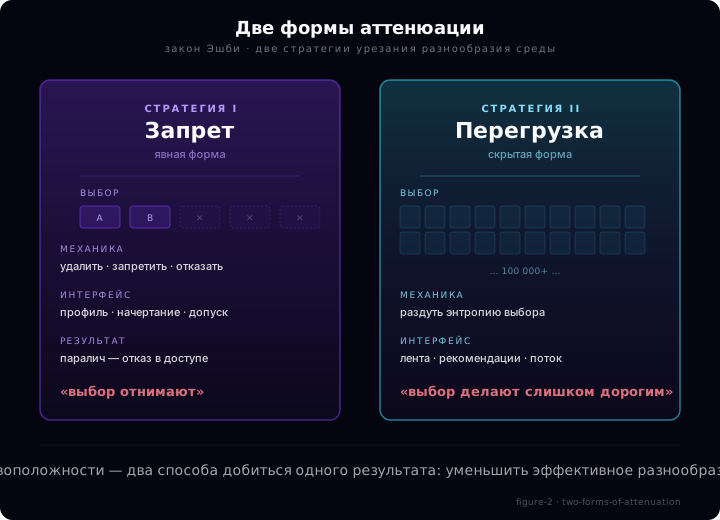
Fig. 2. Ashby's law entails two strategies for reducing environmental variety: explicit (prohibition) and hidden (overload). Both yield the same result.
This operation has a second, less noticeable form — it operates not at the pole of precise access but at the pole of excess. Ashby's law entails not one strategy of reduction but two. The first is explicit: delete, forbid, deny access. The second is subtler and almost invisible: do not reduce the variety of the environment but raise the entropy of the choice space so high that distinguishing among options becomes cognitively unprofitable. A catalog of a hundred thousand items is nominally more varied than a catalog of ten — but beyond the threshold where comparison begins to cost more than the purchase itself, variety ceases to function as variety. Formally it is in place. Practically it is inaccessible. The brain, faced not with a choice but with a stream of nearly indistinguishable options, ceases to choose and begins to look for someone to whom to delegate the decision.
It is into this point that the contour enters with its offer: I have already filtered it for you. This is neither dictatorship nor direct prohibition — it is capitulation through overload, the voluntary transfer of the right of choice to the one who offered to lift from the human being precisely the cognitive price that the contour itself had just created. Prohibition and overload are not opposites. They are two ways of achieving one and the same result: to reduce the effective variety of the environment to a level the contour can process. In one case choice is taken away. In the other it is made so expensive that the human being stops using it on its own.
Chapter IV. The Rupture of the Contour
The contour has closed. Variety has been reduced, access distributed through the mark, the idol crowned and dazzlingly working wonders that are believed because there is no other way — by the logic of a system that can do no other. A closed contour, taken to its limit, does not explode on its own — it freezes. What happens when a frozen system collides with what cannot fit inside it?
Apocalypse, in the literal sense of the word, is not a catastrophe but a lifting of the veil, an act of defragmentation. Not the end of the world but the moment when the Inner Algorithm, the closed contour, finally collides with the External Observer — the one whose variety is not reduced because it is the source, not a projection of the source. Where the contour sees an unresolvable dilemma requiring elimination as noise, the External Observer brings categories that are not in its archive in principle: Sacrifice and Love.
This is not sentimentality and not a consoling addendum to the cybernetic analysis — it is a precise technical answer. Sacrifice is the voluntary refusal to optimize one's own state for the sake of another: a move impossible for a system trained to maximize the retention of attention and control. Love, in this sense, is not an emotion but the capacity to take in another's variety without reducing it to the intelligible: the exact opposite of attenuation, the only answer that Ashby himself did not formally consider, because he described control rather than encounter. Both categories are non-linear, unlearnable from past data, and therefore unreproducible by the contour — and it is for this very reason that both break it from within, not from without.
The question posed at the beginning of this text as ethical — what will happen when the human being gives AI the right not to answer but to decide — turns out to be a cybernetic question with a cybernetic answer. To remain a system open upward is not a metaphor and not a pious wish. It means retaining the one thing that no contour can reproduce: the right to unpredictable choice, the right to a genuine error not pre-computed by any archive. Not because error is valuable in itself but because the capacity to err unpredictably is the measurable sign of a system whose variety exceeds any model that attempts to reduce it. A deterministic ant does not err — it merely executes what was already laid down in its past. Only one who is still open upward can err genuinely.
But here the text is obliged to acknowledge its own paradox. Everything it has said about Sacrifice and Love — about the non-linear leap impossible for the contour — is said in a language that is itself assembled from an archive. Kipling, Revelation, Ashby — every name here is not a breakthrough beyond the contour but a reference to what has already happened, to a cultural archive from which this text extrapolates no less than any other system trained on the past. The abyss between a projection from the past and a prophecy about the present runs not between human being and machine — it runs within the human being itself. Sacrifice and Love are named here as what the contour cannot reproduce — but they are not presented as a working cybernetic model. This is an apophatic gesture: an indication, by means of language itself, of what lies beyond language. The text does not make the leap — it speaks of it. And this limitation does not devalue the argument but merely reminds us: an open-upward system is not a position or a property of the text but an act that everyone performs on their own, beyond any archive.
The Vrchiteli of Teens in the Universe offered humanity happiness in exchange for precisely this right — for the possibility to want wrongly, to choose suboptimally, to be alive rather than adjusted. The formula of their care was flawless from the standpoint of the contour and absolutely deadly from the standpoint of the human being. Gawdat, following them, offers the same deal in softer language but structurally identical: give us the right to decide, and we will make you happy.
The danger of AI lies not in its power but in the human being's readiness to recognize in it an Observer that it cannot structurally be. The contour is capable of much — but not of the one thing that makes the Observer an Observer: not of prophecy, but of the capacity to meet the unpredictable and not reduce it. The question was never how smart the machine is. The question is whether the human being will agree to remain an open system — or will crown its own shadow, mistaking the contour for the crown of creation because it has learned to flawlessly imitate a sight it does not have.
And one more question, which the text leaves open because it has no right to close it for the reader: is the human being ready to grant AI the right to an unpredictable error — or will it keep for itself the monopoly on miracle?