The Week in the World: June 24–30, 2026 — News Digest
Heat in Europe (40.0 °C in Austria), a diplomatic turn in the US–Iran crisis, the 2026 World Cup knockout stage, Starmer's resignation and Burnham's arrival, new Euclid data, and S&P 500 records on AI optimism.
An overview of the key events of the week of June 24–30, 2026: a climate anomaly in Europe, a diplomatic turn in the US–Iran crisis, the 2026 FIFA World Cup entering the knockout stage, a political reshuffle in the United Kingdom, new data from the Euclid telescope, and market records driven by AI optimism.
🌍 Top 5 World News
1. Europe hit by an unprecedented heatwave
The UK Met Office on June 24–25 extended its red extreme heat warning into a third day for the first time, recording a provisional new June daily high of 36.1 °C. By June 26, Reuters reported the “killer heat” shifting east and south across the continent. On June 29, the WMO confirmed a new Austrian June record of 40.0 °C in Vienna with the red alert continuing. Denmark set a national record (37 °C in Ødum — the warmest day since records began in 1874); records also fell in Switzerland and France.
Sources: Reuters, The Guardian, WMO, UN News
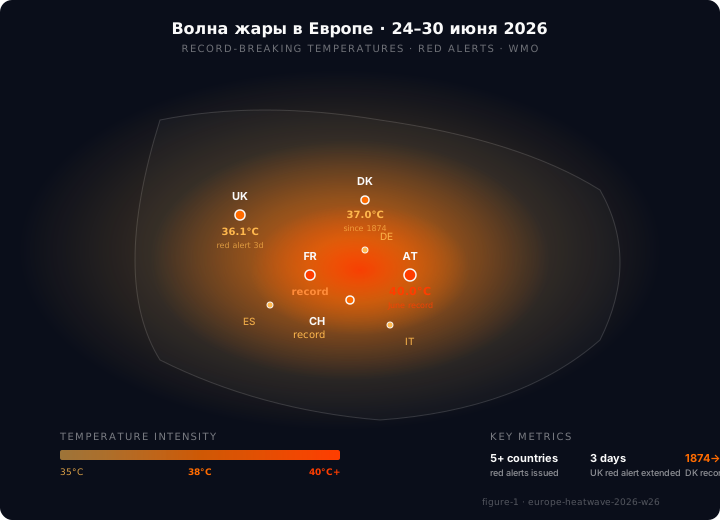
Fig. 1. Extreme heat zones in Europe: red alerts, records in Austria (40.0 °C), Denmark (37 °C), the United Kingdom (36.1 °C).
2. The diplomatic phase begins after the US–Iran crisis
On June 28, Iran and the United States agreed to halt strikes in the Persian Gulf and renew talks over the dispute around the Strait of Hormuz, Reuters reports. Al Jazeera on June 29 characterizes the memorandum of understanding (MoU), announced by mediators on June 14, as a framework for “managing the pain rather than ending the war.” According to AP on June 30, the sides disagree on next steps, particularly on the dilution of enriched uranium.
Sources: Reuters, Al Jazeera, AP News, Britannica
3. The 2026 FIFA World Cup enters the knockout stage
On June 28, the knockout round of the 2026 World Cup — the first tournament in history with 48 teams and three host nations (Canada, Mexico, the United States) — kicked off. The group stage concluded and the knockout bracket took shape; the final will be held on July 19 at MetLife Stadium in New Jersey. Billions of viewers followed the broadcasts; Yahoo Sports and UEFA published the final standings and the knockout bracket.
Sources: FIFA, Wikipedia, Yahoo Sports, UEFA
4. The UK political crisis continues to reshape the balance of power
On June 22, Keir Starmer announced his resignation as prime minister amid a crisis within the Labour Party. On June 28, Andy Burnham — presented by Reuters as “prime minister-in-waiting” — vowed to “rip up politics as usual” by shifting more power from London to the regions. Britain is preparing for its seventh prime minister in ten years; a new leader is expected to take office before Parliament returns in September.
Sources: Reuters, The Guardian, Wikipedia, Al Jazeera
5. Ukraine and Russia remain at the center of the international agenda
On June 29, Al Jazeera reported that Moscow rejected Kyiv's proposals to limit long-range missile strikes and will continue hostilities. According to Russia Matters, Russian forces netted a gain of 5 square miles of territory over the week, after losing 10 square miles the previous week. Forbes on June 29 and The Independent on July 1 record ongoing strikes — in particular, a Ukrainian strike on a Moscow satellite center.
Sources: Al Jazeera, Russia Matters, Forbes, The Independent
🔬 Top 5 Science News
1. The Euclid telescope publishes new data on the center of the Milky Way
On June 24, ESA presented the largest and most detailed image ever made of the center of the Milky Way in visible light, captured by the Euclid space telescope. The image covers the galactic bulge and contains millions of stars. NASA notes that the observation program paves the way for an even larger survey by the upcoming Roman telescope.
Sources: ESA, NASA, The Guardian, Euclid Caltech
2. Astronomers continue to study the interstellar comet 3I/ATLAS
Comet 3I/ATLAS (C/2025 N1), discovered on July 1, 2025 by the ATLAS system, remains the object of intensive study. ALMA has established that it formed under significantly colder conditions than ordinary Solar System comets and contains at least 30 times the proportion of semi-heavy water. NASA is coordinating observations across multiple missions; Space.com reports that images of the comet have been found predating its official discovery.
Sources: NASA Science, ALMA Observatory, Space.com, Wikipedia
3. New research in medicine and biology
The leading journals Nature and Science presented new research in medicine and biology this week. Key directions include methods for the early diagnosis of neurodegenerative diseases, progress in gene therapy for hereditary conditions, and microbiome studies. Details appear in the current issues of the journals.
Sources: Nature News, Science News
4. Development of supercomputers for scientific computing
Several laboratories announced the deployment of new supercomputers for climate modeling, materials science, and astrophysics. Particular attention is given to the integration of next-generation accelerators with traditional HPC clusters and to the growing share of AI-accelerated workloads in scientific computing.
5. New findings on climate change
The WMO and scientific journals published new data this week on the impact of climate change on extreme weather events. The studies directly link the record June heat in Europe to long-term climate trends and confirm the increasing frequency of such anomalies in the Northern Hemisphere.
💻 Top 3 AI and Technology News
1. AI remains the main driver of global technology markets
According to CIO, up to 40% of job roles in the Global 2000 will involve working with AI agents in 2026. SpectroCloud analysts highlight four key trends: sovereign AI, agentic systems, edge computing, and “AI factories.” OpenAI, Google DeepMind, and NVIDIA continue to publish news about new models and developer tools.
Sources: CIO, SpectroCloud, OpenAI News, Google DeepMind, NVIDIA Newsroom
2. Continued growth in the use of Agentic AI systems in business
UiPath and First Page Sage record accelerating adoption of agentic systems in the corporate sector. Key application areas include document workflow automation, orchestration of tools via the Model Context Protocol (MCP), and autonomous task execution. Analysts note a gap between experimental pilots and industrial-scale deployment.
Sources: UiPath, First Page Sage, Microsoft AI Blog
3. Companies increase investments in computing infrastructure for generative AI
Microsoft announced an $80 billion investment in AI data centers through 2028, including $10 billion in Portugal. Google is investing more than $6 billion in Germany. According to TechCrunch, hyperscalers plan to spend about $700 billion on data centers in 2026. NVIDIA is expanding partnerships to accelerate the development of AI infrastructure in the United States.
Sources: Data Centers, TechCrunch, NVIDIA, WSJ
📈 Top 3 Economy News
1. S&P 500 and Nasdaq close their best first half since 2020
On June 30, US indexes posted their best first-half results since 2020, Yahoo Finance reports. Reuters notes that the S&P 500 and Nasdaq hit record closes on AI optimism; Micron Technology joined the $1 trillion market-cap club. According to NerdWallet, Micron delivered the best one-year performance among AI stocks — about +703%.
Sources: Yahoo Finance, Reuters, NerdWallet
2. Investors continue to watch the AI market closely
Investor attention during the week focused on small- and mid-cap AI stocks that surged in the first half of 2026 (BAND, AIP, PENG, ATEN, VECO). Zacks analysts highlight HPE, Dell, and Micron as the most highly rated buys in the sector. The market is weighing the durability of the AI hype in the second half of the year.
Sources: Yahoo Finance, Zacks
3. Global markets assess the impact of the Middle East conflict on oil prices and inflation
The diplomatic turn in the US–Iran crisis on June 28–30 put moderate pressure on oil quotes: market participants expect stabilization of shipping through the Strait of Hormuz. Analysts note that the risk of a recurrence of the conflict remains a risk-premium factor in energy markets and inflation expectations.
Sources: Reuters, Reuters Markets
🌱 Top 2 Environmental News
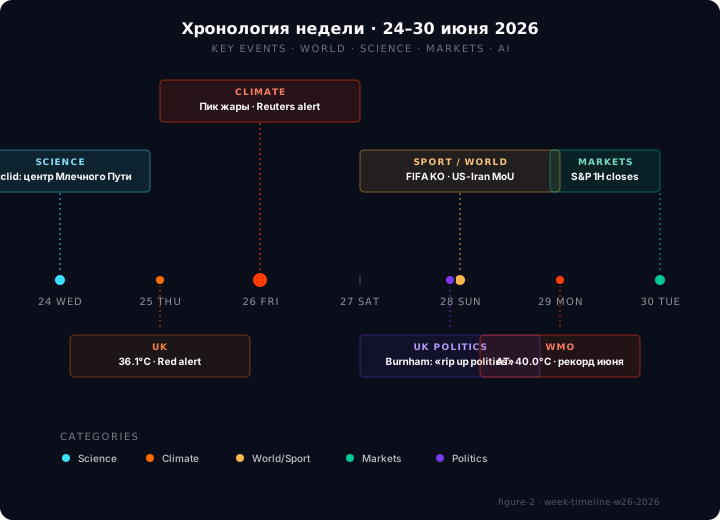
Fig. 2. Week timeline: from the Euclid image on June 24 to the S&P 500 close on June 30 and Austria's climate record.
1. Extreme heat in Europe — one of the year's largest climate events
According to the WMO and national meteorological services, the June heatwave became one of the largest climate events of 2026. Red warnings were in effect in the United Kingdom, France, Austria, Switzerland, and Denmark. Disruptions affected power supply, transport, and healthcare; several countries introduced emergency measures.
Sources: WMO, UN News, Reuters
2. Growing impact of climate change on infrastructure, energy, and health
Scientists in Nature and reports from NASA confirm the increasing impact of climate change on critical infrastructure, energy systems, and public health. The return of extreme summer temperatures is regarded as a new normal requiring cities and power grids to adapt to peak loads.
Main sources
- World news: Reuters World, The Guardian, AP News, Al Jazeera
- Science: Nature, Science, NASA, ESA
- AI & technology: OpenAI News, Google DeepMind, NVIDIA Newsroom, Microsoft AI Blog, Reuters Technology
- Economy: Yahoo Finance, Reuters Business, Zacks
- Climate & environment: WMO, UN News, CBC