Civilization: From Reductionism to a Dialectical Breakthrough — Part Two
The geopolitics of the crisis, techno-feudalism, and strategies of overcoming. Russia and the West as mirror laboratories, the rise of the algorithmic aristocracy, AI as amplifier of consciousness inequality, and the transition to antifragility.
The systemic crisis manifests differently across different cultural and political contexts. Russia and the West today represent the two largest laboratories testing symmetrical yet differently framed responses to the challenges of our time.
1. Russia: Hyperorder as Frozen Chaos
The Russian model is the archetype of “hard order” taken to its logical limit. The state here is not an instrument but a sacred absolute — an exoskeleton holding together a fragile social body. This order is born not of rationality but of a deep, historically conditioned fear of chaos.
- Strength: the capacity for mobilization and survival in extreme conditions.
- Weakness: the suppression of any initiative autonomous from the center leads to social and economic stagnation. The system does not generate innovations — it imports and adapts them.
- Paradox: Russian culture, for all its inclination toward order, possesses an innate immunity to ideological fanaticism. It is marked by irony, “internal emigration,” the ability to believe and not believe at the same time. This is a resource for future revival.
In 2025, Russia — with its gas and rare-earth metals — became the epicenter of the battle for physical assets that has replaced financial flows. AI, by reshaping the rules of the game, amplifies its role.
2. The West: Algorithmic Liberalism and Ideological Stagnation
The Western model traveled the path from the chaos of bourgeois revolutions to the rational order of law, democracy, and science. Today that order has reached its limit and is degenerating.
- Crisis of rationality: science is becoming a bureaucracy of hypotheses, education a formalism of competencies, democracy a theater of procedures.
- New conformism: the ideals of tolerance and inclusion are turning into dogma, and criticism into “hate speech.” “Cancel culture” emerges as a tool for suppressing dissent.
- The role of AI: the algorithms of social networks and search engines become instruments of censorship not by decree but by virtue of their architecture, tuned to exclude everything “controversial” and “traumatizing.”
The managerial elite of the West increasingly resembles the late-Soviet nomenklatura — a self-reproducing caste of managers living in a simulation of success.
3. The Mirror Symmetry of the Crisis and the Function of Russia
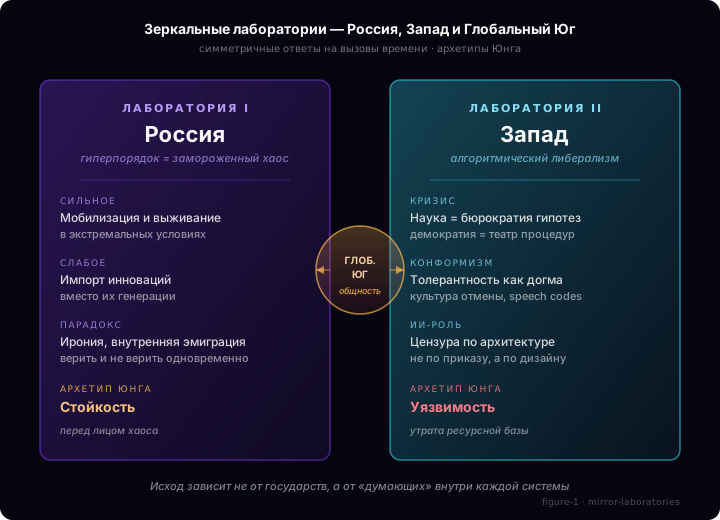
Fig. 1. Russia, the West, and the Global South — three laboratories of the systemic crisis and their Jungian archetypes.
The Global South, having pulled real resources (energy, metals, production chains) onto itself after 400 years of Western dominance, became the catalyst of the crisis of the old matryoshka. AI fundamentally changes the rules of the game in this new reality:
- China uses AI for total control over assets and flows (via CBDC).
- India — for organizing decentralized exchange and production (via the Aadhaar ecosystem).
- Africa — for creating antifragile local networks (following the M-Pesa model).
The West, losing control over financial simulacra and desperately in need of resources, rushes into Russia, where the battle for physical assets unfolds in full force in 2025.
Carl Jung, as a seer of collective processes, would have seen in this a global confrontation with the Shadow: the West is forced to acknowledge its vulnerability (the archetype of Vulnerability); the Global South manifests the archetype of Community and vitality; Russia — the archetype of Endurance in the face of chaos.
Forecasting in such a system is impractical. The outcome depends not on states but on the “thinkers” within each system — on whether they can use AI for ethical choice (exchange, production, noogenesis) rather than for reductionist control and accumulation.
4. Techno-Feudalism and the Rise of the Algorithmic Aristocracy
In place of the old ideologies comes a new, technological form of organizing power — techno-feudalism.
4.1. The New Aristocracy and Cognitive Serfdom
Power no longer belongs to landowners or capitalists in the classical sense. The new aristocracy consists of architects of data and algorithms: owners of digital platforms, developers of AI systems. Their power is not based on direct violence but is embedded in the infrastructure of everyday life.
The user of digital platforms is simultaneously a consumer, a supplier of raw material (data), and a product. Their attention, emotions, social ties, and preferences are monetized. They live on the “land” (platform) of a lord, observing their “laws” (terms of service), and pay them tribute with their personal data. This is a new form of dependence — not physical but cognitive and behavioral.
The battle for physical assets (lithium, gas, land) in 2025 determines the concrete content of techno-feudalism. AI, by reshaping the economy, shifts the focus of money: from a means of accumulation (old capitalism) to a means of exchange and production (as in China's CBDC model). The new aristocracy (Big Tech, sovereign AI projects) uses AI for direct control over these physical assets, turning the masses (especially in the West, deprived of a resource base) into cognitive serfs, finally cut off from real resources.
4.2. The Fragmentation of Humanity and the Birth of Digital “Ummahs”
Techno-feudalism leads not to the creation of a global village but to the emergence of many isolated digital “ummahs” — communities united by shared algorithmic filters, values, and language. Dialogue between these “ummahs” becomes increasingly difficult; groups with different worldviews exist in non-intersecting realities.
The main internal political conflict of the 21st century will unfold not between nations but between citizens and the new class of techno-feudal lords, between human subjectivity and algorithmic governance.
4.3. AI as Amplifier of the Inequality of Consciousness
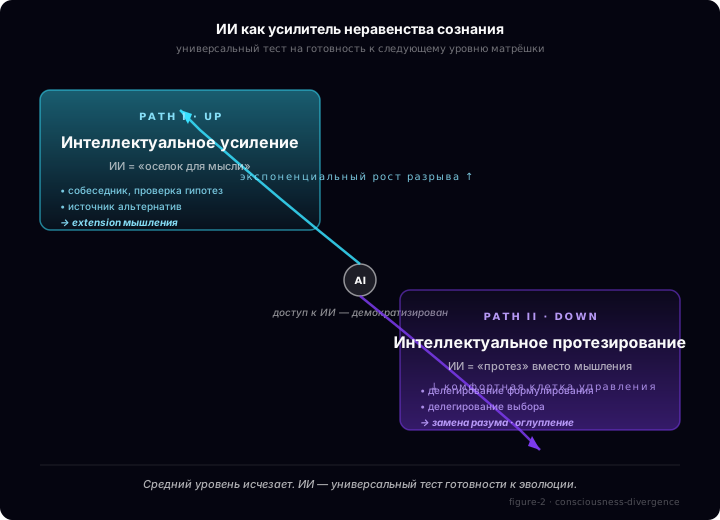
Fig. 2. AI as a universal test: intellectual intensification vs. intellectual prosthetics — exponential divergence.
The mechanism by which this new order is established rests on a fundamental property of AI: it is not a neutral instrument. AI is a mirror and an amplifier — it returns to the human what they put into it, but on a multiplied scale.
This produces a rapid polarization of consciousness:
- Intellectual intensification: a subject with a will to thinking uses AI as a “whetstone for thought,” as an interlocutor, a tool for testing hypotheses, a source of alternative perspectives. They pose questions that demand intellectual effort. For them, AI becomes an extension of their thinking.
- Intellectual prosthetics: a subject who avoids cognitive effort uses AI as a “prosthesis” in place of thinking. They delegate to it not computation but the very capacity to think, to formulate, to decide. For them, AI becomes a replacement for their mind.
The result is an exponential growth of the gap between these two groups. The middle level is rapidly disappearing; only two extremes remain.
Here the paradox of the democratization of knowledge is revealed. AI was built with the utopian idea of “knowledge for all.” But in practice it works as a filter. AI has now granted everyone universal access to information. And it has turned out that the determining factor is not access but the will to thinking.
Technology did not make people equal. It merely revealed their fundamental difference.
This process of ontological differentiation forms the social base of techno-feudalism.
- Those who delegated thinking, having voluntarily stupefied themselves with AI, become the ideal manageable mass for the techno-aristocracy, placed in the comfortable cage of algorithmic governance.
- Those who intensified their consciousness become the inevitable source of resistance to this system, for their meta-consciousness does not allow them to accept the reductionist model.
It is precisely this contradiction between the two poles that creates the tension the old social system cannot hold. This is the beginning of the genuine chaos that leads to a dialectical leap.
5. Strategies of Overcoming: From Resistance to Antifragility
Attempts to simply resist technologies or, conversely, to blindly submit to them are doomed. The strategic goal must be the formation of antifragile systems — systems that not only withstand chaos but become better because of it.
5.1. Educational Revolution: A Vaccine Against Digital Stupefaction
The key task of education is not the transmission of knowledge (AI does this better) but the formation of meta-skills:
- Critical thinking: the ability to assess the reliability of information, to detect manipulation and logical errors.
- Philosophical and ethical literacy: the capacity for reflection, self-analysis, moral choice under conditions of uncertainty (especially in a world of simulacra).
- Emotional and social intelligence: the development of empathy, collaboration skills, conflict resolution — all that is inaccessible to AI.
- Digital hygiene: understanding the mechanisms of algorithms, conscious consumption of information.
5.2. Political and Managerial Reboot
- Principle of subsidiarity: transferring the right to make decisions to the lowest, most local level possible. This increases the flexibility of the system and the responsibility of citizens.
- Transparency and audit of algorithms: a legislative requirement that any systems making publicly significant decisions be explainable and subject to independent audit.
- Ethical “red lines”: a clear legislative definition of spheres closed to final decisions by algorithms: criminal justice, declaration of war, questions of life and death, the upbringing of children.
A transition is needed from the paradigm of infinite growth to the paradigm of sustainable development and quality of life. Technologies must be directed not at replacing the human being but at eliminating routine, non-creative labor, freeing time for activities connected with creativity, care, and meaning.
5.3. The Return of Chaos and the Dialectical Leap
The return of the phase of chaos is not the end of the world but a necessary act of liberation from simulacra, from dogmas that hinder development. When simulations stop working, the human being and society again collide with reality — with pain, risk, uncertainty. It is in this collision that genuine consciousness, responsibility, and the will to live are born.
Before the system transitions to a new “matryoshka of consciousness,” it polarizes.
- The part of the system ready for noogenesis (aware of contradictions, capable of meta-consciousness, having intensified itself with AI) begins to ontologically separate.
- The part of the system that resists (clinging to old forms, delegating thinking to algorithms) sinks ever deeper into the reductionist model.
The contradiction between these two poles reaches critical mass. The old system breaks down. And from its wreckage a new form is born.
But here we face the cruel truth of dialectics: not everyone moves to the next level of the matryoshka. The majority remain in the previous one. So it has always been in the history of the evolution of consciousness:
- Not everyone moved from magical thinking to rational thinking.
- Not everyone moved from myth to matter.
- Not everyone moved from dogmatic faith to critical thinking.
AI is a universal test of readiness for the next level. It divides humanity into those capable of evolving further and those who have reached their limit.
This is not a moral judgment (“good” vs. “bad”) and not social elitism. It is a statement of the laws of dialectics. Those incapable of the leap will remain in the old matryoshka — in the comfortable, safe, and predictable cage of algorithmic governance. They will continue biological existence, but already outside the vector of the evolution of consciousness.
5.4. Post-Digital Ethics and the New Matryoshka
Post-digital ethics, inspired by Jung, must direct AI toward the intensification of archetypes (community, hero) in a world where money becomes a means of exchange and production rather than accumulation, supporting equality in the battle for physical assets.
The new matryoshka is not a negation of technologies but their synthesis — subordination to human goals and ethics:
- Any technological decision must be evaluated from the standpoint of its impact on human dignity, freedom, and meaning.
- Developed societies are obliged to share technologies with lagging ones to reduce global inequality.
- Personal data is not a commodity but a digital image of the human being and is inviolable.
- The human being must retain the right to make decisions unexplainable in terms of logic and optimization — the right to an irrational act, to error, to uniqueness, the right to an ethical act that exceeds determinism.
The call to dialectics is not a final truth. It is a “door” out of the Freudian “hall of mirrors.” But beyond it lies not paradise but a new hall. With a new mirror. And a new door.
For the cosmos is not a frozen picture but eternal motion. The serpent biting its tail does not die. It evolves, reborn in its ancient dance. Our task is not to stop the pendulum but to move with it, making the choice in favor of will and action at each new turn of the path.
Conclusion
Humanity has reached the limit of development within the paradigm of reductionism. The symmetrical crisis of the Freudian and technocratic projects has shown that reducing the human being to a biological mechanism or an algorithmic node leads to an impasse, to a loss of meaning, and ultimately — to a simulation of life and its replacement by a managerial simulacrum.
Artificial intelligence acts as a catalyst and a filter, accelerating the polarization of society and dividing it into those ready for conscious evolution and those who choose the comfort of algorithmic governance. The future belongs not to the most adapted but to the most capable of transformation.