The Physics of Optical Computing: Why Photons, Not Electrons
Why light computes: electron vs photon, the Mach–Zehnder interferometer, WDM, and three things a photon cannot do. The physics of optical processors. Part 1.
Key takeaways
- Modern AI has hit a wall not so much in computation itself as in its physical cost: most of a processor's energy goes into moving data, not arithmetic.
- The difference between an electronic and an optical chip is physical: the electron has mass and charge, the photon has neither, and in a linear medium it practically does not interact with neighboring photons.
- Three properties of light that change computing: wavelength-division multiplexing (WDM), low ohmic losses in transmission, and interference that multiplies matrices in a single pass.
- Three limitations of the photon: no natural nonlinearity (hence no logic gates), no static optical memory, and analog precision of about 5–8 effective bits in published prototypes.
- That is why a real optical computer is a hybrid: light moves and multiplies, silicon remembers and decides.
- Photonics changes not the architecture but the physical carrier of information transmission and processing — for the first time in seven decades since the invention of the transistor.
The carrier: electron vs photon
Modern AI has hit a wall not so much in computation itself as in its physical cost. Most of a processor's energy goes not into arithmetic but into moving data — and this expense is growing faster than any other. That is why engineers increasingly ask a question that sounded marginal only ten years ago: can the electron be replaced by the photon?
To answer honestly, we have to start with physics. Any computer is a machine that moves and transforms physical carriers of information. In a silicon chip the carrier is the electron. In an optical one it is the photon. Everything else in this article follows from the difference between these two particles.
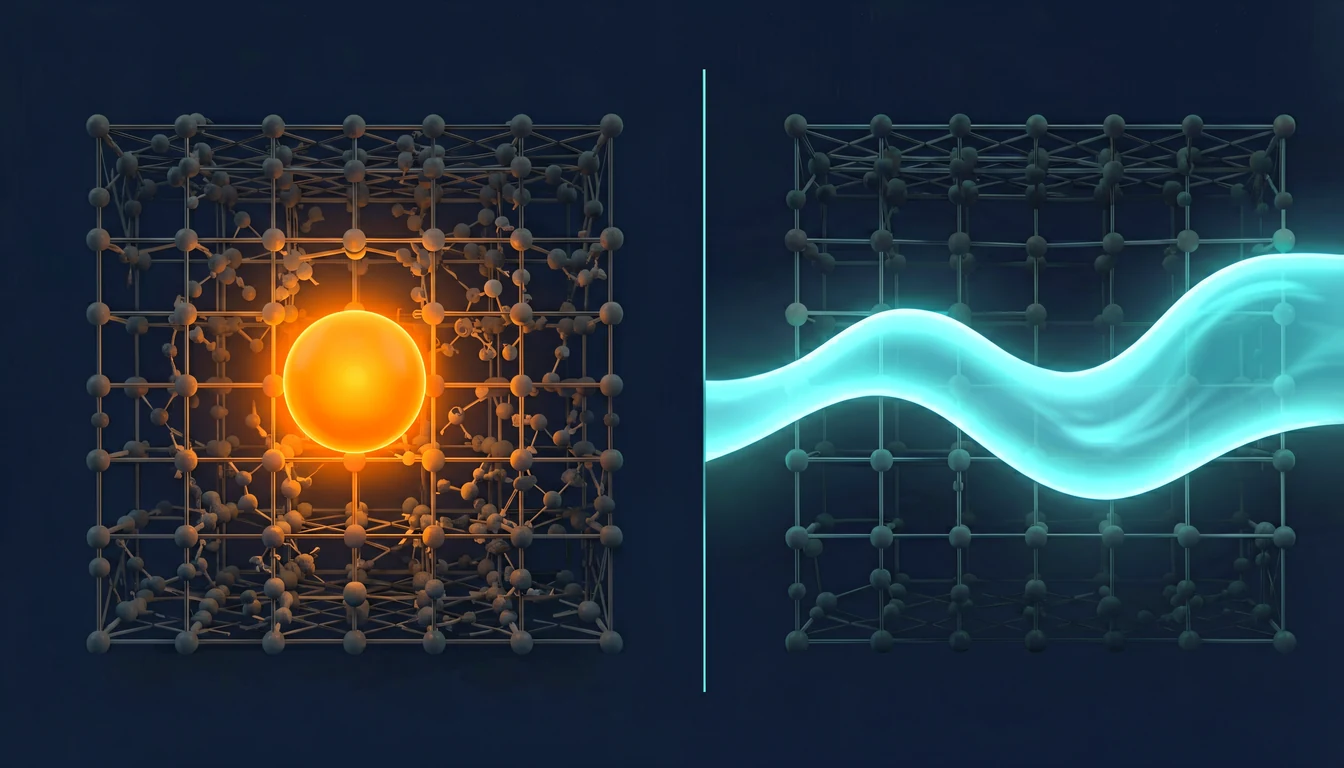
The electron is a particle with rest mass and a negative charge. When it flows through a conductor, it collides with lattice atoms: that is electrical resistance. Each collision turns part of the energy into heat — the very processor heating that coolers and liquid cooling fight. This is not a defect of specific chips but a property of the electron as such: the denser the transistors and the higher the frequency, the more heat must be removed, and it is the thermal ceiling — not logic — that limits computing density.
The photon is a quantum of light with no rest mass and no charge. In a good waveguide it propagates with practically no ohmic losses — it meets no resistance in the sense an electron does: it does not "squeeze" through the lattice and does not heat it. Where the electron must overcome resistance, the photon simply flies.
There is a second difference. Electrons interact with each other through the electromagnetic field. Photons in a linear medium practically do not interact: two light beams can cross and continue on, unaffected by each other. For computing this is a double-edged sword — and we will return to this fact.
| Property | Electron (silicon) | Photon (optics) |
|---|---|---|
| Rest mass | Yes | No |
| Electric charge | Yes | No |
| Speed | Carrier drift — fractions of mm/s; signal — fractions of light speed | Speed of light (in silicon ~ c/3.5) |
| Transmission losses | Ohmic; heat is the density limit | Practically absent in a good waveguide |
| Carrier interaction | Strong (Coulomb) | Practically absent in a linear medium |
| State storage | Natural (charge, latch, domain) | No static analog |
Here it is important not to stumble over an apparent contradiction. The electron itself drifts slowly — fractions of a millimeter per second. But the electrical signal propagates along the conductor as an electromagnetic wave, which is why it is fast. Copper's limits are set not by the sluggishness of the carrier but by resistance and capacitance: every bit has to be pushed through, paying with heat and line recharging.
Three properties of light that change computing
1. Independent channels: spectral multiplexing
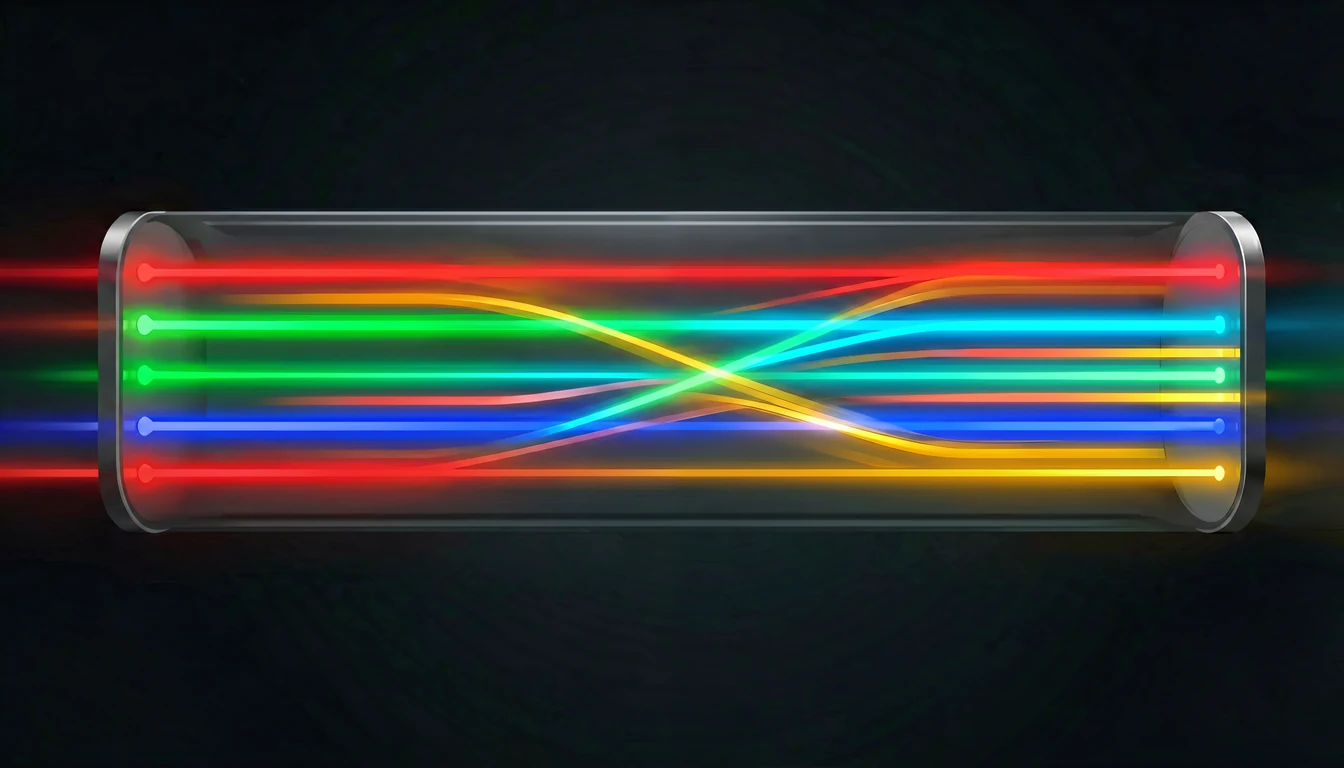
Because photons in a linear medium practically do not interact, dozens or hundreds of independent streams can be sent through a single optical waveguide at the same time — on different wavelengths, that is, on different "colors". Each color carries its own channel and does not disturb the others. This is wavelength-division multiplexing (WDM). Where copper hits frequency limits and crosstalk, light simply adds new wavelengths.
Analogy: a copper line is a single-lane road where cars go single file. A WDM waveguide is a multi-lane highway where each lane is its own color, and the lanes never cross.
2. Cheap movement: low ohmic losses
In an electronic chip the lion's share of energy goes not into computing but into moving data: sending a bit means charging and discharging the line capacitance against resistance. Energy grows with distance and frequency — this is the interconnect wall. For a photon, what remains expensive is creating light (the laser) and receiving it (the detector); propagation through the waveguide itself is almost free. That is why optics wins wherever data must travel a distance: between chips, racks, cluster nodes. The longer the path, the more light beats copper.
3. Interference: multiplication by physics itself
Light waves can interfere — combine, amplifying or cancelling each other depending on phase. Send two beams through a device that controllably shifts phase and recombine them — the output is a weighted sum. This is computation performed by the physics of propagation rather than by a sequence of clock cycles. Matrix multiplication — the central operation of neural networks — reduces to exactly such weighted sums, and therefore it can be done in a single pass of light through an optical circuit.
The Mach–Zehnder interferometer: how light computes
The basic building block of an optical computer is the Mach–Zehnder interferometer (MZI):
- The input beam is split into two arms — two parallel waveguides.
- In each arm the phase of the light is controllably shifted — by heating or by an electric field.
- The arms recombine: depending on the accumulated phase difference, the light is amplified or cancelled.
A single interferometer implements the simplest operation on two signals — weighted mixing, mathematically a 2×2 matrix. The key trick: from many such interferometers wired into a mesh, an arbitrary matrix transformation is assembled — there are classical schemes showing how any unitary matrix can be decomposed into a chain of elementary "rotations". The matrix is encoded into the mesh geometry and phases; the input vector is fed in as light amplitudes; the result is read out by photodetectors.
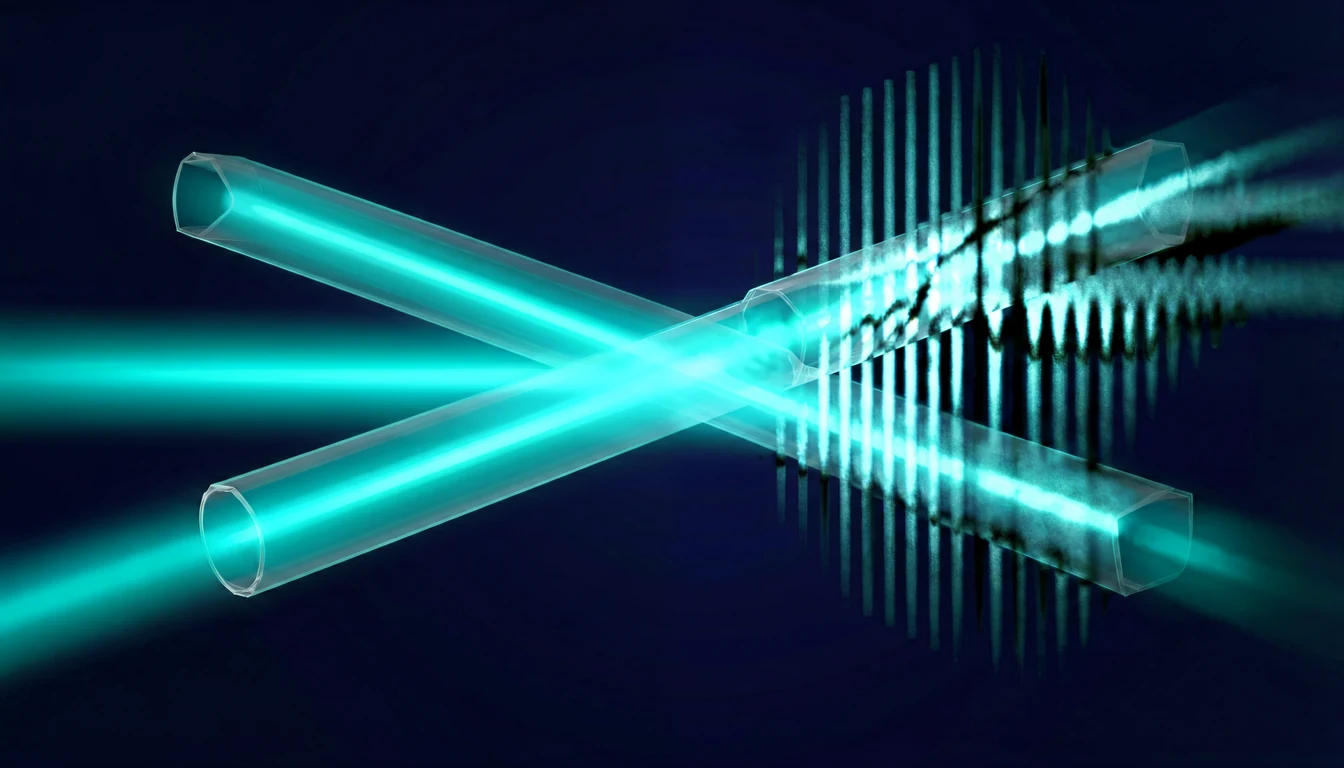
What is fundamental here is that the multiplication itself happens in the time it takes light to pass through the circuit — picoseconds for a millimeter-scale chip. There is no clock generator and no sequential iteration: light "seeps" through the matrix and immediately yields the result. Energy is spent on the laser and detectors, not on millions of transistor switches.
Analogy: electronics multiplies a matrix like an accountant adding numbers in a column, cell by cell. Optics is like a river that, having spread through a system of channels with partitions, "computes" the distribution of flow by itself in a single instant.
Three things light cannot do
If that were all, optics would have replaced silicon long ago. But the photon has three fundamental limitations. Understanding them matters more than understanding its advantages.
1. Nonlinearity: no natural logic gates
Digital logic rests on nonlinearity: one signal must control another. A transistor is a controlled switch: a small voltage on the gate opens or closes a large current. From such switches, AND, OR, NOT gates are built. Light lacks this mechanism by default: one beam cannot switch another on or off, because photons in a linear medium do not notice each other. Nonlinear optical effects (for example, the Kerr effect) exist but are weak: they require either high powers or exotic materials and resonators. In practice, nonlinearity is almost always obtained by converting light back into electricity.
One beam of light cannot command another — which is why the logic of an optical computer still lives in silicon.
2. Memory: a state cannot be fixed in light
Electronic memory works because a state can be fixed: charge on a capacitor, a level on a latch, the orientation of a magnetic domain. A photon is unstoppable by nature — it always moves at the speed of light, and there is no "shelf" to put it on and return to later. The consequence: light has no full static optical memory, no analog of DRAM or SRAM. Information lives in the optical domain only while it flies — along a delay line or in a resonator — or once it has been converted into the state of matter.
3. Precision: analog noise limits bit depth
Electronics is digital: it distinguishes sharp levels and computes with high precision, up to fp64. Optical computing is analog by nature: the result is light intensity, a continuous quantity on which laser noise, thermal phase drift, manufacturing variation and detector noise all pile up.
In published prototypes, the effective precision of matrix multiplication usually falls in the range of about 5–8 bits: a flexible testbed of photonic processors demonstrates around 5.85 bits after calibration, individual chips reach 7–10 bits. It is important to understand: this is not a law of nature, but a limitation of current implementations. Precision can be improved, but the price is an exponential growth in signal-to-noise requirements and more complex calibration. For inference, which tolerates low bit depth, 5–8 bits is usually enough; for training with gradient accumulation, it is not. That is why optics today is above all an inference technology.
Photonic memory: the frontier of the possible
Since a state cannot be fixed in light directly, researchers circumvent the problem in three ways. The first is phase-change materials: a substance switches between states with different refractive indices under a short light pulse, and the state persists — you get a cell that is written and read by light. The second is resonators and delay lines: light circulates in a ring resonator, providing short-term storage for buffers but not long-term memory.
The third path is optical bistability, and here it is important not to confuse two recent works. The earlier proof-of-concept is the programmable photonic latch by F. Ashtiani (Nokia Bell Labs), published in Optics Express (2025): an optical memory cell with an SR-latch architecture built on universal optical logic gates. A separate and frequency-wise more advanced result is the pLatch by the UW–Madison and USC ISI team (Md Abdullah-Al Kaiser, Akhilesh Jaiswal, Sugeet Sunder, Ajey Jacob), presented at IEEE IEDM 2025: a cell fabricated on GlobalFoundries' commercial process with consultations from AIM Photonics, which in simulation writes at ~20 GHz and reads at 50–60 GHz — an order of magnitude faster than electronic SRAM caches running at 2–3 GHz. It is still a laboratory result, but one already reproducible in a fab.
The general conclusion: optical memory exists as a class of devices, but it is years away from a mature DRAM analog — which is exactly why the hybrid architecture is inevitable.
The hybrid as an architectural consequence
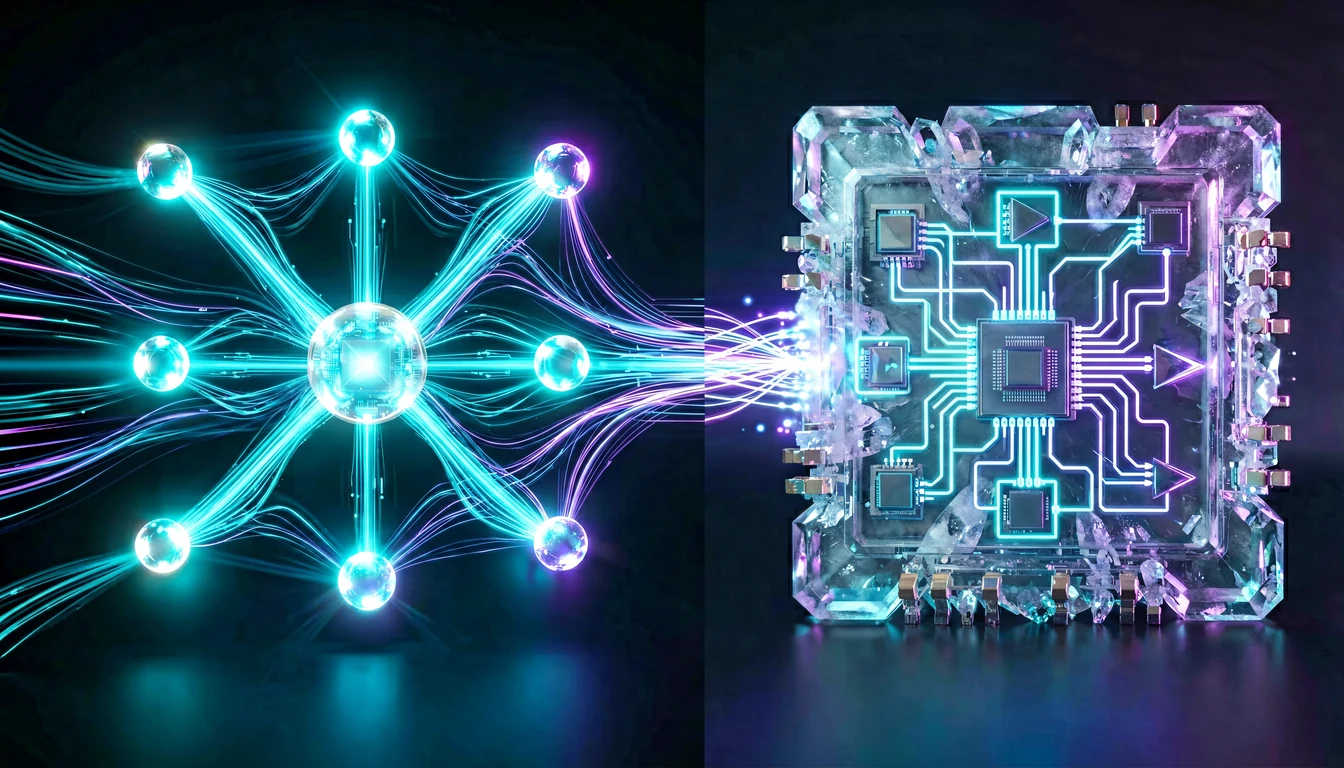
Add up the advantages and limitations — and we get the only sensible architecture. Light does what it does best: moves data (interconnects, WDM, low loss per bit) and multiplies matrices (interference, analog speed). Electronics does what only it can do: store state and make decisions — logic, branching, control. An "optical computer" in the real world is not a machine made entirely of light, but a precise division of labor, where light occupies the niches between chips and inside matrix blocks, and silicon is the memory and the controller. Success is determined not by the "purity" of the optics but by the quality of this division.
An optical computer is not a machine made of light. It is a precise division of labor between light and silicon.
Coda: a change of carrier
The shift from the electron to the photon is not just another architectural change: there have been many architectural reshuffles, from GPUs to TPUs and analog accelerators. Photonics changes something else — the physical carrier of information transmission and processing itself, for the first time in seven decades since the invention of the transistor. The scale of this shift is precisely defined by the physics described above: light removes the bottlenecks of movement and multiplication — the interconnect wall, the thermal ceiling — but it does not remove the questions that arise for any system acting in the world.
In the history of computing there have already been changes of architectures, languages and algorithms — just as in the history of quantum computing, another physical paradigm we covered in The Quantum Revolution. Today, for the first time in decades, the physical medium of computation itself is changing. Perhaps one day this very transition will be regarded as the beginning of a new era in computer engineering. And who is building the new carrier today, how money and power are distributed in the optical race, and why Google has been running optics in production for years — in the second part of the diptych, "The Optical Race of 2026: Google, NVIDIA and the Three Waves of Photonics".