The Week in the World: July 1–7, 2026 — News Digest
Strait of Hormuz escalation: Iran attacks three vessels and the U.S. strikes Bandar Abbas, the Venezuelan earthquake death toll climbing to 3,342 with seven days of national mourning, Messi's records at the 2026 World Cup and Norway's sensation, Khamenei's funeral (Tehran—Qom—Najaf), the NATO summit in Ankara, a miss on the U.S. jobs report (57,000 vs 115,000), Brent oil surging to $109.03, OpenAI proposing a 5% stake to Trump, Anthropic overtaking OpenAI in valuation for the first time, heatwaves in Europe and North America.
An overview of the key events of the week of July 1–7, 2026: an escalation of the Strait of Hormuz crisis and U.S. strikes on Iran, the Venezuelan earthquake death toll climbing to 3,342, the drama of the 2026 FIFA World Cup knockout stage, the state funeral of Ali Khamenei, the NATO summit in Ankara, Messi's World Cup record, a miss on the U.S. jobs report, and continuing climate anomalies.
🌍 Top 5 World News
1. The Strait of Hormuz crisis escalated sharply: Iran attacked three vessels, the U.S. struck back
On July 7, Iran attacked three commercial vessels near the Strait of Hormuz, including the Qatari LNG tanker Al Rekayyat, owned by Nakilat. According to AP and Al-Monitor, this is the first attack on a Qatari vessel since the war began on February 28; the tanker was reported at risk of explosion. In response, the U.S. revoked the temporary sanctions waiver for Iranian oil issued under the Islamabad Memorandum, and struck Iranian air-defense, coastal surveillance, and missile sites — explosions were reported in Bandar Abbas, Bandar Sirik, and on Qeshm Island. Iran accused Washington of violating the memorandum of understanding and warned of retaliation. Earlier, on July 1, U.S. Vice President J. D. Vance confirmed that Iran and the U.S. had held technical talks in Doha on the 14-point memorandum; on July 4, Oman concluded an agreement with France and the United Kingdom to ensure safe navigation in waters adjacent to the strait.
Sources: CNN, Al Jazeera, AP News, BBC, Britannica
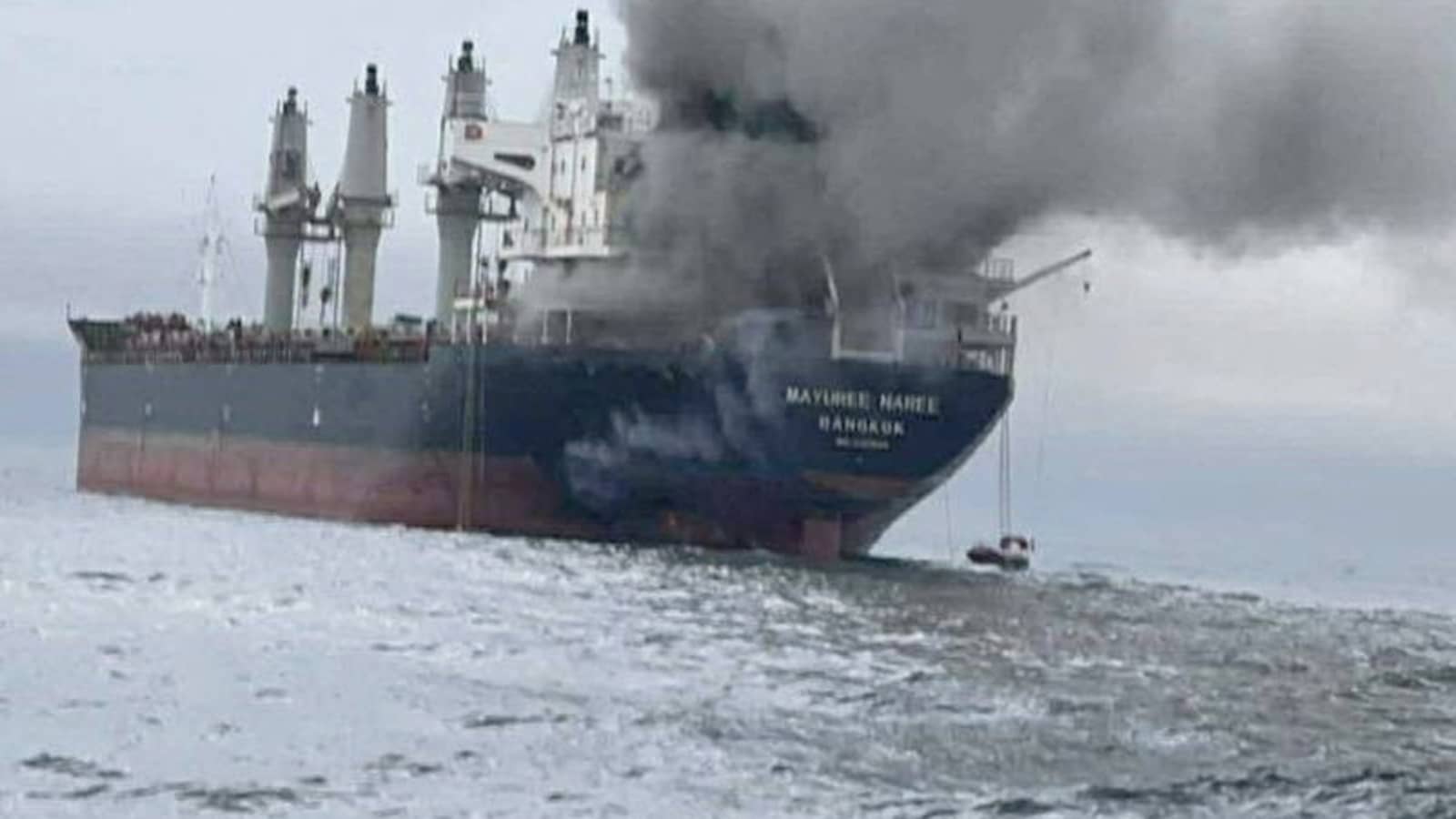
Fig. 1. The cargo vessel MAYUREE NAREE burns in the Strait of Hormuz. On July 7, Iran attacked three commercial vessels, including the Qatari LNG tanker Al Rekayyat; the U.S. struck Iranian military sites in Bandar Abbas, Bandar Sirik, and on Qeshm Island in response. Photo: CNBC.
2. Venezuela earthquake: death toll climbs from 2,295 to 3,342 during the week
On July 1, Venezuelan acting president Delcy Rodríguez declared seven days of national mourning: according to National Assembly President Jorge Rodríguez, the death toll from the twin earthquakes of June 24 (magnitudes 7.1 and 7.5) had risen to 2,295, with more than 11,000 injured. By July 5, Reuters reported, citing official figures, that the death toll had reached 3,342, with 16,470 injured and 17,345 left homeless; tens of thousands were reported missing. According to Britannica, these are the strongest earthquakes to hit Venezuela since 1900. The NYT published an analysis on July 3: more than 400 buildings were destroyed, hundreds more severely damaged; rescue efforts are complicated by infrastructure destruction. Wikipedia cites a final toll of more than 4,100 dead. International relief teams continue to work in the northern states of the country.
Sources: Reuters, AFP via France 24, The Standard, Britannica, The New York Times, Wikipedia
3. The 2026 FIFA World Cup knockout stage: Messi's records, Norway's sensation, and the Trump red-card scandal
From July 3 to 7, the knockout round of the 2026 World Cup took place. On July 3, Lionel Messi — in the match against Cape Verde (3:2) — became the first player in history to make 30 World Cup appearances, score 20 World Cup goals, and score in eight consecutive World Cup matches; on July 7, he extended the streak to nine matches by scoring against Egypt. Egypt reached the Round of 16 for the first time in its history, defeating Australia 4:2 on penalties. On July 5, Norway reached the World Cup quarterfinals for the first time, defeating Brazil 2:1 — Brazil's earliest elimination since 1990. Spain set a tournament record with a sixth consecutive clean sheet in the knockout stage (1:0 over Portugal), and goalkeeper Unai Simón extended his scoreless streak to 609 minutes. Switzerland reached the quarterfinals for the first time since 1954, defeating Colombia on penalties. On July 5, a scandal erupted: following the intervention of U.S. President Donald Trump, FIFA overturned the suspension of American forward Folarin Balogun for a red card — the first such overturn since the introduction of the automatic suspension system.
Sources: ESPN, FIFA, UEFA, Wikipedia, BBC News (Balogun)
4. The state funeral of Ali Khamenei took place in Tehran, Qom, and Najaf
On July 3, state funeral ceremonies for former Iranian Supreme Leader Ali Khamenei — killed in an Israeli–U.S. airstrike on his compound on the first day of the Iran war on February 28 — began in Tehran. The body lay in state at Tehran's Grand Mosalla mosque complex; the procession then moved to Qom, where Khamenei had studied, and on July 7 to the Shiite holy city of Najaf in Iraq. According to AFP and The Guardian estimates, the ceremonies drew millions of attendees, including foreign dignitaries; former Iranian President Mahmoud Ahmadinejad made a public appearance at the funeral, his whereabouts after a strike on his home having been the subject of rumor. The funeral became the largest political event in Iran since the Islamic Revolution.
Sources: The Guardian, The New York Times, Reuters World, AFP via France 24, Iran International
5. The NATO summit in Ankara: Trump revived the Greenland question and lifted sanctions on Turkey
On July 7, the NATO summit was held in Ankara. U.S. President Donald Trump renewed his calls for the United States to take control of Greenland and stated that America could withdraw troops from Europe if the dispute is not resolved. In parallel, Trump announced the lifting of sanctions against Turkey that had been imposed in 2020 over Ankara's purchase of Russian S-400 surface-to-air missile systems. The summit took place against a backdrop of continuing disagreements within the alliance on defense spending, support for Ukraine, and relations with Russia; the situation in the Strait of Hormuz was discussed on the sidelines. According to CNBC, Trump's statements on Greenland caused tension with Denmark and other European allies.
Sources: CNBC, Defense News, Reuters Europe, NATO
🔬 Top 5 Science News
1. ESA gets the green light for the Ramses mission to asteroid Apophis
The European Space Agency (ESA) has begun work on the planetary defense mission Ramses (Rapid Apophis Mission for Space Safety) to the near-Earth asteroid (99942) Apophis. In cooperation with JAXA, the probe will accompany Apophis during its close approach to Earth on April 13, 2029, observing how the planet's gravity alters the asteroid's shape, surface, and motion. The launch is scheduled for 2028. Apophis, discovered in 2004, will pass about 32,000 km from Earth's surface — within the geostationary orbit. The UN has declared 2029 the International Year of Asteroid Awareness and Planetary Defence.
Sources: ESA, ESA–JAXA, SpacePolicyOnline, UN
2. NASA releases a guide to the July sky: a parade of planets, a returning comet, and a new angle on Saturn's rings
NASA has released its monthly skywatching guide "What's Up: July 2026 Skywatching Tips". The main recommendation is a predawn alignment of the Moon with Jupiter, Venus, and Mars in mid-July, when the planets will be so close together that they can be covered with a finger at arm's length. Astronomers are also promised good viewing of the Milky Way from the Northern Hemisphere, a new angle on Saturn's rings (their tilt relative to Earth has changed), and the return of a periodic comet not previously observed from Earth. The guide is aimed at amateurs and experienced astronomers alike and is available on the NASA Science website.
Sources: NASA Science, Space.com
3. The Hubble Telescope detected ultraviolet light from a galaxy in the early universe
Astronomers working with the NASA/ESA Hubble Space Telescope have detected ultraviolet radiation from a galaxy that existed at an early stage of the universe's evolution. The finding was unexpected: it had been thought that the intense interstellar absorption in that era would have completely blocked the UV range. The result forces a rethinking of models of the formation of the first galaxies and the ionization of the intergalactic medium. The discovery came as part of Hubble's current observing cycle, which continues to operate in orbit more than 35 years after launch.
Sources: ESA/Hubble, ESA/Webb, NASA Hubble
4. Japan's Hayabusa2 probe flies by asteroid 98943 Torifune
On July 5, the Japanese probe Hayabusa2 — which previously delivered samples of the rubble-pile asteroid Ryugu to Earth — flew by asteroid 98943 Torifune. The flyby is part of the probe's extended mission after the completion of its main program. According to NHK, detailed images and spectral data were obtained during the encounter, which will help refine the object's composition and evolutionary history. The Hayabusa2 mission remains one of the principal tools for studying small Solar System bodies and provides a foundation for future missions to Apollo-group asteroids.
Sources: NHK, JAXA, ESA Space Science
5. Scientists propose a lunar quarantine for samples from Mars and the Moon
On July 6, ScienceDaily reported that an international group of scientists has called for the creation of a lunar quarantine — a specialized facility on the Moon where samples from Mars, the Moon, and other Solar System bodies would undergo primary analysis before being delivered to Earth. In the researchers' view, such an approach would reduce the risk of contaminating Earth's biosphere with extraterrestrial microorganisms and, at the same time, protect the samples themselves from terrestrial contaminants. The proposal is being discussed in the context of planned Mars Sample Return missions and the resumption of the Artemis lunar program.
Sources: ScienceDaily (ESA), Nature News, NASA News
💻 Top 3 AI and Technology News
1. OpenAI proposed giving the Trump administration a 5% stake in the company
On July 2, the Financial Times reported that OpenAI is discussing giving a 5% stake to the U.S. government in exchange for the removal of political obstacles. At a potential valuation of $852 billion, the stake would be worth about $42.6 billion. According to CNBC, TIME, The Guardian, and Axios, the talks are at an early stage; the company is seeking to improve relations with the Trump administration amid growing regulatory pressure and antitrust interest in the consolidation of the AI industry. The deal, if it closes, would be an unprecedented case of direct government participation in a private technology company and could set a template for future "sovereign AI agreements" in other jurisdictions.
Sources: Financial Times, CNBC, TIME, The Guardian, Fortune
2. Anthropic overtook OpenAI in secondary-market valuation for the first time; Fable 5 relaunched globally
On July 1, Anthropic globally relaunched the Fable 5 model and proposed an industry-wide framework for scoring jailbreak attacks; the company also announced Sonnet 5. On July 3, according to AIToolsRecap, Anthropic surpassed OpenAI for the first time in secondary-market valuation — a milestone signaling a changing of the leader in the generative AI industry. Fortune published a lengthy essay by Sam Altman on July 2 about a "new world order for AI", in which the OpenAI CEO acknowledges that Anthropic is overtaking OpenAI in self-reported revenue and is gradually catching up in user count. The shift marks the end of OpenAI's hegemony, held since the launch of ChatGPT in 2022, and turns the competition into a "two titans" format — against a backdrop of growing pressure from regulators and investors demanding transparency in model-training costs.
Sources: Anthropic Newsroom, Fortune, MarketingProfs, AIToolsRecap via unrot
3. Taiwan detains Supermicro employees over alleged shipments of NVIDIA AI servers to China
On July 2, Taiwanese prosecutors detained two Supermicro employees as part of an investigation into alleged document forgery and the shipment of NVIDIA GPU-powered AI servers to China in violation of U.S. export controls. According to AFP, the case is one of the first major tests of the new U.S. restrictions on AI chip exports to China, introduced earlier in 2026. NVIDIA has not officially commented on the incident; Supermicro shares showed increased volatility on the news. The case underscores how the geopolitical confrontation over AI is increasingly spilling over into criminal law enforcement.
Sources: AFP via The Manila Times, Reuters Technology, Bloomberg Technology
📈 Top 3 Economy News
1. The U.S. jobs report for June: only 57,000 new jobs versus 115,000 expected
On July 2, the U.S. Bureau of Labor Statistics released its June employment report. Only 57,000 jobs were created — about half of the 115,000 economists had expected; the unemployment rate fell to 4.2%. Data for the previous two months was revised downward. Reuters and The Guardian describe the figures as a sharp cooling of the labor market; the NYT notes that employers continue to retain staff but barely expand payrolls. CNBC emphasizes that the report strengthens expectations of a Federal Reserve rate cut at its next meeting. According to the BLS, the labor force participation rate has reached an all-time low.
Sources: CNBC, BLS, Reuters, The Guardian, The New York Times
2. Oil spiked on the Strait of Hormuz escalation: Brent +7.78% to $109.03 a barrel
On July 7, on the back of reports of Iranian attacks on three commercial vessels in the Strait of Hormuz, oil prices jumped sharply. According to WAFA, Brent futures rose by $7.87 (+7.78%) — to $109.03 a barrel. WTI showed a comparable increase. The escalation came amid a gradual recovery of exports through the strait after disruptions linked to the Iran war: on July 5, seven OPEC+ countries agreed to raise production quotas by 188,000 barrels per day from August. BloombergNEF analysts had previously forecast that Brent could reach $91 a barrel in the fourth quarter of 2026 in the event of new Iranian disruptions.
Sources: WAFA, Trading Economics, BloombergNEF, Al Jazeera
3. Microsoft cuts 4,800 jobs; the U.S. declines to renew USMCA
On July 6, Microsoft announced the elimination of about 4,800 jobs, primarily in its Xbox and commercial sales divisions; at the same time, the company is divesting four game studios — Compulsion Games, Double Fine, Ninja Theory, and Undead Labs. According to Reuters and The Verge, the cuts are part of a continuing restructuring of the gaming industry that began in 2022. Earlier, on July 1, U.S. Trade Representative Jamieson Greer stated that the United States would not renew the USMCA trade agreement initiated during Trump's first term; instead, the agreement will undergo annual reviews. On the same day, Saudi Aramco announced a 24–27% reduction in liquefied petroleum gas prices for July, and the World Bank reclassified the Philippines as an upper-middle-income country.
Sources: Reuters Business, The Verge, CBC News, World Bank
🌱 Top 2 Environmental News
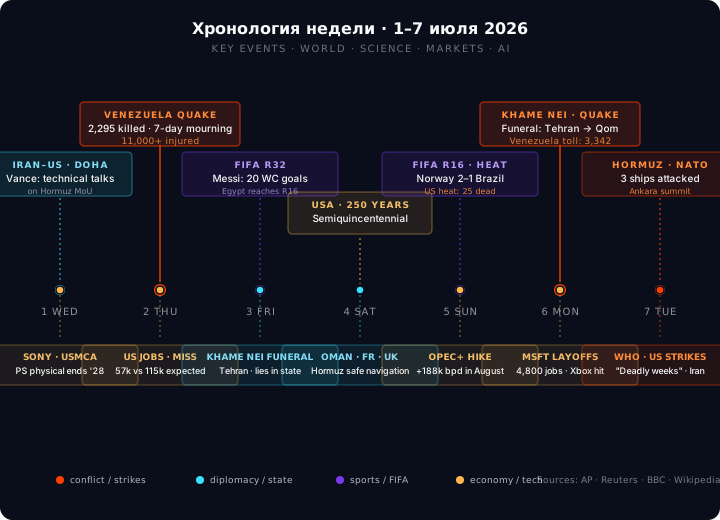
Fig. 2. Week timeline: from the Iran–U.S. technical talks in Doha on July 1 to the Strait of Hormuz escalation and the NATO summit in Ankara on July 7.
1. Deadly heat in North America: 25 dead, 40 million people under heat alerts
Against the backdrop of the continuing European heatwave that began in June, in the first week of July the heat anomaly spread across the eastern and central United States. According to NBC News on July 5, around 25 people died; 40 million people on the East Coast, the Southeast, and the Southwest were under heat alerts. Reuters and The New York Times note that 23 states were under National Weather Service warnings. Carbon Brief on July 7 characterized the situation as a "heat dome" smothering the eastern half of the United States. In Europe, according to Euronews, mortality in Belgium in June rose 39% compared to the previous week, and in France by 29.1%; Le Monde reports that in the week of June 22–28 alone, more than 2,025 people died from heat in France.
Sources: NBC News, Reuters Environment, Carbon Brief, Euronews, Le Monde
2. The WHO warned of "even more deadly weeks" in Europe as a new heatwave builds
On July 7, the World Health Organization warned that Europe could face "even more deadly weeks": a new intense heatwave is forming. According to Reuters, the WHO statement followed the publication of data from national meteorological services indicating that the June anomaly was one of the largest climate events of 2026: red warnings were in effect in the United Kingdom, France, Austria, Switzerland, and Denmark. The UK Met Office reports that after a brief return to average temperatures early in the week, a new heatwave is expected by the weekend. Scientists regard the return of extreme summer temperatures as a new normal requiring cities and power grids to adapt to peak loads.
Sources: Reuters (WHO), UK Met Office, UN News, The Guardian
Main sources
- World news: Reuters World, The Guardian, AP News, Al Jazeera, BBC News
- Science: ESA, NASA, ESA/Hubble, Nature, ScienceDaily
- AI & technology: OpenAI News, Anthropic, Reuters Technology, Financial Times, CNBC Tech
- Economy: Yahoo Finance, Reuters Business, CNBC Economy, U.S. BLS
- Climate & environment: WMO, UN News, UK Met Office, Carbon Brief