Civilization: From Reductionism to a Dialectical Breakthrough — Part One
A systemic crisis of the Enlightenment paradigm: Freudian and technocratic reductionism as two sides of the same coin — and a dialectical way out through free will. Matryoshkas of consciousness, the paradox of awareness, and ethics as a simulacrum.
Contemporary humanity is confronted not with a multitude of disparate crises — economic, ecological, political — but with a systemic crisis of the very paradigm of consciousness inherited from the Enlightenment. This crisis manifests in two seemingly opposite yet essentially symmetrical forms:
- Psychological reductionism, originating in Freud's project, which reduced the entire complexity of the human soul — its highest manifestations such as love, creativity, altruism, the search for meaning — to the sublimation of basic instincts and the consequences of childhood trauma. In this model, the human being is a “monkey with complexes,” driven by the blind forces of the unconscious.
- Technocratic reductionism, reaching its apex in the AI era, which seeks to reduce human thought, decision-making, and social life itself to algorithmically optimizable processes. In this model, the human being is a data source and a node in a network whose behavior can be predicted and controlled.
Both projects are two sides of the same coin — the mechanistic worldview. Both propose totalitarian systems of interpretation that:
- Declare any resistance to their logic a pathology (“resistance” in psychoanalysis, “deviation” in algorithmic governance).
- Deny free will as an ontological reality.
- Ignore the emergent nature of human consciousness — its capacity to produce qualities irreducible to the sum of its parts.
The result has been the formation of a society trapped in a double impasse:
- The impasse of infinite reflection: a culture obsessed with “processing trauma,” where introspection has become a substitute for action and the awareness of pain a surrogate for the will to overcome it.
- The impasse of algorithmic optimization: a social system striving for total control and predictability, yet thereby suppressing the very sources of innovation and adaptation — chaos, chance, freedom of choice.
This double impasse produces the phenomenon of accumulated civilizational entropy. The system's energy is spent not on development but on maintaining the illusion of stability and suppressing mounting internal contradictions. The pendulum of history, frozen at the extreme point of order, is preparing for a powerful reverse swing.
The way out of this crisis lies not in refining old paradigms but in dialectical synthesis — recognizing the crisis as a necessary condition for a qualitative leap, for the transition to a new stage in the evolution of consciousness.
1. Freudianism as an Unfinished Revolution and Its Degeneration
Sigmund Freud's project began as a bold attempt to map the terra incognita of the human psyche. Challenging the hypocrisy of the Victorian era, he relocated the source of morality from the divine sphere into the inner world of the human being, declaring repressed libido the “priest” of the soul. Yet this revolutionary attempt quickly degenerated into a new dogmatic system — a secular religion of the unconscious, possessing all the attributes of clericalism:
- The Holy Scripture — the 24 volumes of Freud's writings.
- The priesthood — certified analysts who have undergone “didactic analysis.”
- The ritual — the session on the couch, free association.
- The dogmas — the Oedipus complex, libido, repression.
- Sin — the neurotic symptom.
The key mechanism of this system was total interpretation: any objection to the theory was declared “resistance,” thereby confirming its truth. This transformed psychoanalysis from a scientific hypothesis into an irrefutable faith.
But the main problem of Freudianism lay deeper — reductionism. By elevating instincts to the rank of humanity's chief engine, Freud proposed a “zoologized” model of the human being. Love, creativity, sacrifice, the search for the transcendent were declared sublimation — a complex superstructure over basic drives. In this system, no room remained for spirit, freedom, or the disinterested striving for meaning. The human being turned out to be a complex biological mechanism driven by blind forces from the basement of their own psyche.
This reductionist model became a powerful ideological weapon. It allowed any inconvenient behavior to be marginalized by declaring it “neurotic” or “immature,” rather than entering into substantive dialogue. In the era of mass media and clip thinking, Freudianism — a crude and universal “brick” — triumphed over the precise but training-requiring “pistol” of the scientific method.
2. Technocratic Reductionism: AI as Heir to the Mechanistic Worldview
The technocratic project, reaching its apex in the development of artificial intelligence, is a direct heir to the mechanistic worldview of the 17th–18th centuries. If Freud reduced spirit to biology, technocracy reduces mind to algorithm.
Modern AI, especially large language models, is based on the logic of statistical prediction. The goal is not understanding meaning but generating plausible data sequences. This produces fundamental contradictions:
- Truth vs. Plausibility: AI is optimized not for correspondence to reality but for the creation of convincing narratives. “Hallucinations” are not a bug but a systemic feature.
- Freedom vs. Predetermination: algorithms seek to eliminate uncertainty, offering “ideal” behavioral trajectories, thereby narrowing the space for spontaneous choice and unpredictable creativity.
- Efficiency vs. Meaning: AI, optimizing measurable KPIs (productivity, engagement, profit), ignores everything that resists quantitative assessment — meaning, beauty, love, tragedy.
Falling into the hands of elites governed by short-term interests and desires, AI becomes an instrument of hyperscaled control. It allows systemic problems to be masked rather than solved: creating the illusion of feedback, generating pseudo-rational justifications for unpopular decisions, conducting micro-targeted propaganda.
3. The Symmetry of the Two Projects
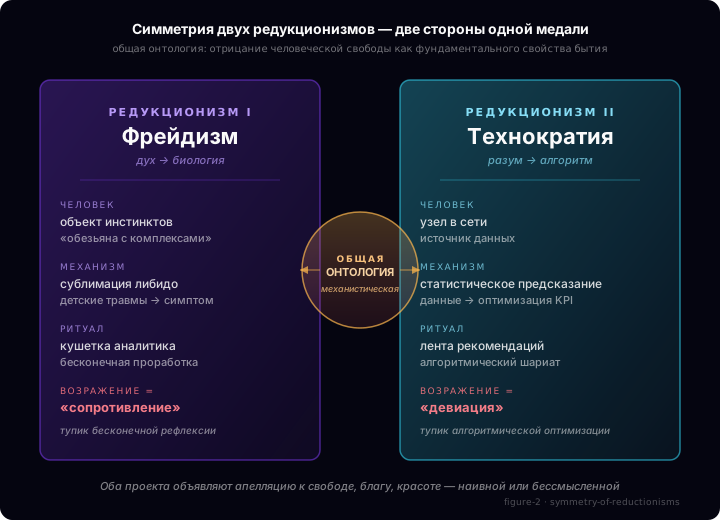
Fig. 1. Freudianism and technocracy — two reductionisms sharing a common ontology: the denial of human freedom.
Despite their apparent differences, Freudianism and technocracy rest on a common ontological premise: the denial of human freedom as a fundamental property of being.
- Both see the human being as an object, not a subject: for one, an object of instincts; for the other, an object of algorithmic governance.
- Both propose deterministic models — psychological and digital.
- Both create systems in which appeals to higher values (goodness, truth, beauty) are deemed naive or meaningless.
It is precisely this shared ontology that makes them two sides of the same coin — the coin of a civilization of reductionism that has reached its developmental limit.
Overcoming the crisis requires a change not of specific practices but of the paradigm itself. A transition is needed from the metaphysical method characteristic of reductionism to the dialectical one.
4. Comparative Analysis: The Metaphysical and Dialectical Methods
Freudianism, in seeking to “heal” the human being of contradictions, was in fact attempting to nullify the very essence of the human — the capacity for inner conflict and its overcoming. Technocracy, in seeking total order, suppresses chaos — the source of innovation and adaptation. To clarify the difference between these approaches, let us compare the metaphysical method (underlying both reductionisms) and the dialectical method (the only one adequate to the crisis).
| Aspect | Metaphysical method (Freudianism, Technocracy) | Dialectical method |
|---|---|---|
| Causality | Linear, mechanistic (trauma → symptom, data → solution) | Non-linear, systemic (contradiction as the engine of development) |
| Time | The rule of the past over the present. The future as extrapolation of the past | Accumulation of quantitative changes in the past leads to a qualitative leap in the future |
| Conflict | Pathology to be eliminated or suppressed | The norm, the source of motion and evolution |
| Ideal | Homeostasis, stability, return to equilibrium | Transformation, continuous development, passage through crisis |
| Human being | A mechanism that can be “repaired” (by analysis or optimization) | A process, an unfinished project that cannot be halted without killing it |
This table does not merely describe two philosophical positions — it exposes the reason why reductionism inevitably leads civilization into an impasse. The metaphysical method treats contradiction as an error to be corrected; the dialectical method treats it as the condition of growth. In the first language of the world, crisis is a signal of failure; in the second, a bifurcation point at which a new form is born.
5. The “Matryoshkas of Consciousness” Model: Dialectics of the Evolution of Mind
The evolution of consciousness cannot be described linearly, but it can be represented as “matryoshkas of consciousness” — a sequence of nested levels of organization, where each subsequent one arises from the previous but is not reducible to it, possessing emergent properties.
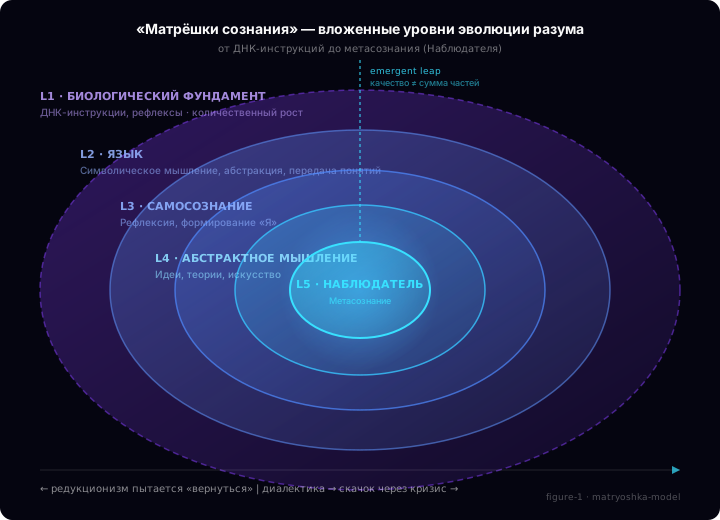
Fig. 2. Five nested levels of the evolution of consciousness — from the biological foundation to meta-consciousness (the Observer).
- Biological foundation (DNA instructions, reflexes). The first, smallest matryoshka. The accumulation of experience — quantitative growth.
- Language. A qualitative leap. Symbolic thinking arises — the capacity for abstraction, for the transmission of complex concepts.
- Self-consciousness. A new level: reflection, the ability to think about one's own thinking, the formation of the “I.”
- Abstract thinking. The birth of ideas, theories, philosophical systems, art — not directly tied to immediate survival.
- Meta-consciousness (the Observer). The capacity to become aware of the very processes of thinking, their limitations, their cultural and historical conditioning.
While inside our current level, we perceive it as the only reality. We do not see its boundaries. But within each layer, inner contradictions are ripening. Each matryoshka solves some problems but inevitably generates new ones.
- A child's magical thinking provides a sense of safety but is powerless before injustice.
- A teenager's rationalism breeds cynicism.
- An adult's existential thinking creates personal meaning but turns into the burden of responsibility and loneliness.
Contradictions accumulate. Quantity passes into quality. And at some point, the layer cracks. Crisis sets in. Chaos. These are the birth pangs of the new, when from the wreckage of the old form a matryoshka is born capable of containing and resolving the contradictions of the previous one.
Freudianism and technocracy attempt to “patch” the cracks in our matryoshka, to return to homeostasis. Yet dialectics speaks of a path forward — through accepting the crisis and making the leap.
6. The Paradox of Awareness
At the very heart of the reductionist project lies a paradox that destroys it. Both Freudianism and technocracy are based on determinism. But the very act of becoming aware of the determining mechanism is an act of freedom.
If I am able to recognize that my actions are determined by childhood trauma or an algorithmic recommendation, then I am no longer their slave. I become the breaking point of the deterministic chain. I am a “glitch in the matrix.”
This paradox resonates with the fundamental discoveries of 20th-century science:
- Gödel's incompleteness theorem: any sufficiently complex formal system cannot be both complete and consistent. It inevitably contains statements that can be neither proved nor disproved within its framework. A system cannot fully describe itself.
- Heisenberg's uncertainty principle: the very act of observation affects the observed system. It is impossible to simultaneously measure precisely both the position and the momentum of a particle.
Transferring this logic to the realm of consciousness, we arrive at the conclusion: consciousness is a glitch in a deterministic Universe. And a glitch is a form of life. Freedom is not an illusion but a manifestation of the fundamental incompleteness and openness of any system, including the Universe itself.
Freud's own end — his voluntary departure from life — became an inadvertent confirmation of this thesis. A man who built a theory about the power of unconscious drives proved the reality of free will with his last conscious choice. Will turned out to be the final and highest form of human dignity.
7. Pop-Freudianism
Psychoanalysis in the 20th century underwent a surprising transformation: from a therapeutic instrument it became the language of mass culture. Its concepts — the “Freudian slip,” the “Oedipus complex,” the “subconscious” — entered everyday vocabulary, becoming convenient labels for explaining human behavior.
In the era of social networks, this process reached its apex. The confession on the analyst's couch degenerated into stories and posts. Trauma, once the subject of intimate healing, became currency in the attention economy. Suffering turned into content, and its public discussion into performance.
This produced a culture of infinite reflection about damagedness. The awareness of pain, which for Freud was a means to catharsis and healing, became an end in itself. The process of “processing trauma” replaced the will to overcome it, the courage to change oneself and reality. A peculiar cult of vulnerability took shape, in which the display of one's wounds is valued above strength, endurance, and responsibility.
8. Techno-Sharia (Techno-Feudalism)
At the other pole, techno-sharia is taking shape — a normative order executed automatically by algorithms, without court, lawyers, or the right of appeal.
- Manifestations: a social media ban by AI decision, a lowered credit score, an automatic refusal of a visa, insurance, or employment.
- The problem: this order is opaque, inflexible, and knows no mercy. It is morality without compassion, law without a judge, justice without a human being.
Algorithms optimized for holding attention reward content based on the simplest stimuli — sex, status, fear, anger, outrage, pleasure. These are bubbles in which groups with different worldviews exist in non-intersecting realities. A common discourse based on shared facts and values becomes impossible.
The language of Freudianism has been turned into an instrument of manipulation. We have learned to justify our passivity by “trauma,” to manipulate those close to us, to blackmail society by appealing to the language of “existential truth” about our inner demons.
The most terrifying thing about this system is the absence of a classical Evil Overseer. We ourselves, voluntarily and enthusiastically, publish the map of our psyche for general access — and algorithms then lead us along it like the blind. We become simultaneously victims and executioners in this grandiose spectacle.
9. Ethics as a Simulacrum
This is not merely a statement of moral decline. It is a diagnosis of the final stage of that very reductionism.
The irony is that the simulacrum of ethics is not a deception but a new reality. It is not “bad morality” but its functional replacement in a system where the human being no longer needs to be the subject of an act. Conscience becomes UX design. The algorithm suggests you not sin not because it is evil but because it is irrational. You do not become better — you simply fit perfectly into the interface.
9.1. Why did ethics not “die” but was deliberately eliminated?
Both projects described — the Freudian and the technocratic — are inherently hostile to traditional ethics.
- Freudianism reduced morality to the sublimation of instincts and social coercion (the “Super-Ego”). Goodness, duty, sacrifice were declared products of repression. Ethics became a symptom.
- Technocracy reduced morality to a set of optimizable parameters: “social responsibility,” “ESG ratings,” “inclusivity.” Ethics became a KPI.
In neither system did any room remain for freedom and responsibility irreducible either to biology or to algorithm.
9.2. Imitation as an instrument of governance in the era of “cognitive serfdom”
A system based on reductionism cannot offer genuine ethics. But it is in acute need of its simulation. Why?
- For legitimation: even the most cynical power requires the language of goodness and justice to justify its actions. Thus is born the rhetoric of “values,” which serves merely as a cover for the interests of techno-sharia.
- For governance: modern human beings, unlike the slave or the serf, must not merely obey but believe in the rightness of their obedience. The imitation of ethics creates this illusion. The “ethics of inclusivity” masks total censorship. The “ethics of sustainable development” masks predatory consumption. The “ethics of mental health care” masks the suppression of social protest.
This is the highest form of manipulation, in which the human being is made to accept their unfreedom as moral progress.
9.3. Mass manipulation as a systemic necessity
Under conditions in which genuine ethics, based on freedom and responsibility, is inaccessible, manipulation becomes the only way to maintain the integrity of the system.
- Social media algorithms are machines for producing moral simulacra that evoke the required emotions in the user (outrage, approval, righteous anger) without demanding the slightest moral act from them.
- “Cancel culture” is a ritual of imitating ethical behavior, in which public condemnation replaces the labor of forgiveness, dialogue, and understanding.
- Public “confessions” and “repentances” of corporations and celebrities are performances designed to simulate responsibility without bearing real consequences.
Conclusion: a culture based on reductionism inevitably produces ethics as a simulacrum.
This means that strategies of overcoming must aim not at the “revival of ethics” in its old forms but at a breakthrough toward a new foundation for morality that will be resilient to reductionism.
Such a foundation can only be a dialectically understood freedom — as the capacity for transcendence, for stepping beyond the limits of deterministic systems (biological and algorithmic) in acts of conscious choice. This is the evolution of the capacity for a genuinely ethical act, in which all traditional landmarks have turned out to be simulacra.