The Quantum Revolution: Why the Old World Collapsed
The first article of the series. Consciousness as a fundamental part of reality, not a by-product of the brain. From Laplace's demon to the double slit and the hard problem of consciousness — why the mechanistic picture of the world no longer works.
Four Theses
Before we begin — my position, reduced to four statements. Everything that follows unfolds from them.
First. Consciousness is a fundamental part of reality, not a by-product of the brain.
Second. Science and philosophy describe the same reality from different sides. Their conflict is not about facts but about language.
Third. The main threat to the modern human being is the loss of subjective experience in the pursuit of measurability.
Fourth. We mistakenly consider ourselves separate objects, whereas we are processes within a single system.
I. Prologue: A Universe That Needs You
Today the human being is a mechanism. It is surrounded by tools: communicators, applications, medicinal agents — all of which increase efficiency the way replacing a carburetor engine with a modern fuel-injected one increases the power of a car. An app counts your sleep. A pulse oximeter knows when you are tired before you do. Perhaps this morning you took a drug that reduces nervousness and stimulates brain activity — so your hands would not tremble before a presentation — or another drug to make it to a deadline. You optimize yourself as a system.
But optimization, taken to its end, kills the very thing for which you optimize.
In the beginning was the Word, the Bible says. Absolute Fullness. This state cannot be described in words, because language has a point of reference and cannot characterize the foundational level. Any metaphor is only a pointer to the fundamental state of reality. The Vedic rishis, the Muslim Sufis, the Kabbalists, and some quantum physicists point to the same concept: an undifferentiated field where there is neither time nor space.
There was no time for it to flow. There was no space for something to fit in. There was no motion, for motion implies a change of positions. This is a pure state in which all possible configurations exist in superposition. As the Wheeler–DeWitt equation, derived in 1967, describes — at the fundamental level time disappears. Only the network of correlations between states remains.
We are not the result of a breakdown or an error in a formula. We are a way of knowing.
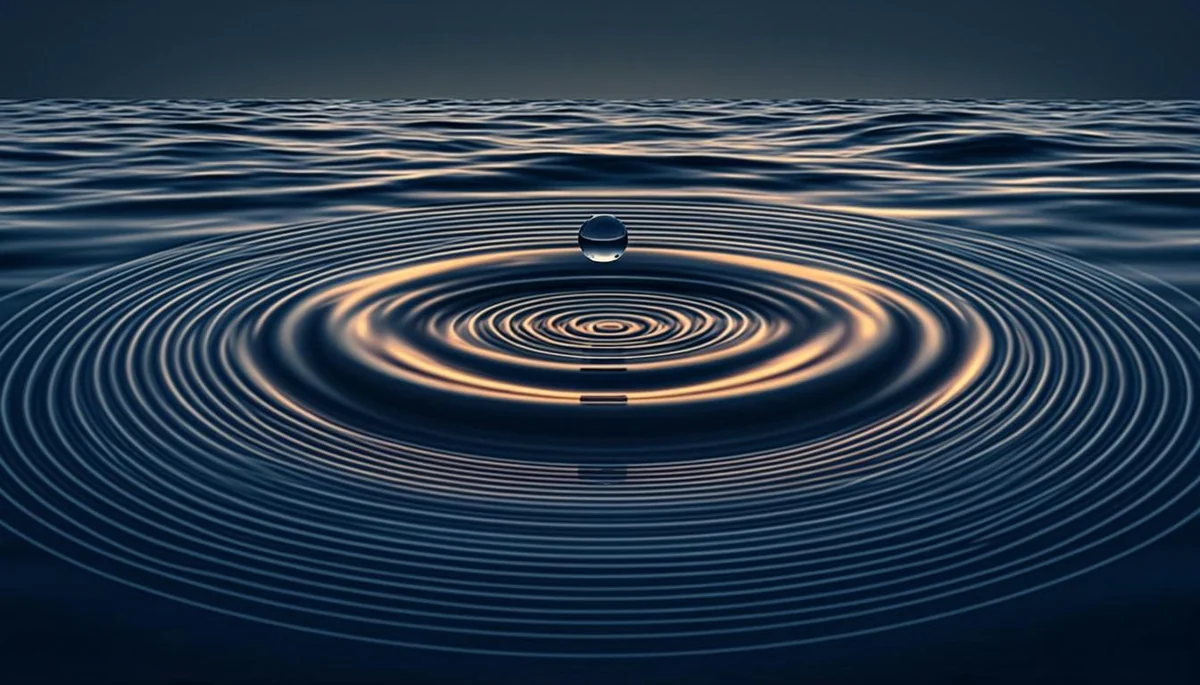
Fig. 1. Ocean and drop. A timeless field in which there is neither time nor space, and the node of observation through which the whole notices itself.
In the depths of the ocean, in absolute stillness, the ocean can know itself only through a drop. The drop is the nerve node through which the ocean knows the world, multiplying experience. The same is true of reality. A timeless field cannot know its own nature while remaining stationary. To experience dynamics, the possibility of change is needed. To understand complexity, one must consent to separation.
The first trembling is not an event in chronological time but an eternal process occurring in every quantum system. The moment reality begins to distinguish states, the field folds for the first time. This fold is Time. Not a river flowing from past to future, but a sequence of frequency correlations necessary for stasis to experience itself as dynamics.
The second fold is Space. To be "here," one must separate "there." This is not an empty arena but correlations between states created by the vibration of the first distinguishing.
The third fold is Matter. What we call "solid" is a frozen configuration: stabilized correlations of the field.
Once Einstein asked Bohr: "Do you really believe the Moon exists only when it is looked at?" Bohr replied: "No, but I cannot prove its existence without observation."
The observer does not create the Moon — he participates in its stabilization as a classical object.
The physicist David Bohm called the Universe a holographic projection. A hologram has the property that every fragment of it contains information about the whole. Break a hologram into a thousand shards, and each shard will show information about the entire system — only with less clarity. Like human DNA: in every cell the entire organism is recorded. Each of us is a fragment of the whole, containing information about all of reality.
You are here because the system evolves. Because the fullness prior to distinction remembers the taste of dynamics, which can be understood only by passing through separation.
You are not the observer of reality. You are the way reality observes itself.
When you look at the stars, you do not see distant objects. You see your own correlation. The light reaching your eyes from Sirius left it more than eight years ago. But for the fullness, where all states exist simultaneously, this light is part of your current configuration. We search for meaning, but it has always been in us.
This is the prologue. If you remember only one thought from this introduction, let it be this: you do not observe the Universe. You participate in its being.
II. The Destruction of the Mechanistic Picture of the World
Laplace's Demon
At the beginning of the 19th century, Pierre-Simon Laplace formulated an ideal that became the manifesto of the scientific worldview for two centuries. Imagine an intellect that at every moment knows all the forces of nature and the positions of all particles. For such an intellect, he wrote, nothing would be uncertain — the future and the past would unfold before it with perfect clarity.
This "demon of Laplace" turned the Universe into a giant clockwork mechanism, and the human being into an observer who stands aside and watches the flawless course of the gears. The scientific method, based on strict causality, seemed the final victory over mysticism.
The First Crack: Planck and the Quantum
But a hundred years later the mechanistic picture began to crack. Max Planck, trying to explain black-body radiation, was forced to assume that energy is emitted not continuously but in discrete portions — quanta. December 14, 1900 is considered the birthday of quantum theory.
The world was no longer continuous. At its foundation, discrete units were discovered.
Two Slits: The Experiment That Won't Rest
In 1801 Thomas Young demonstrated the wave nature of light in a double-slit experiment. Later this experiment was repeated with electrons. A gun fires electrons at a screen with two narrow slits. If no one observes — an interference pattern, alternating bright and dark fringes, appears on the detector. Each electron behaves as a wave, passing through both slits simultaneously.
But place a detector at the slit — to "look" — and the pattern instantly disappears.
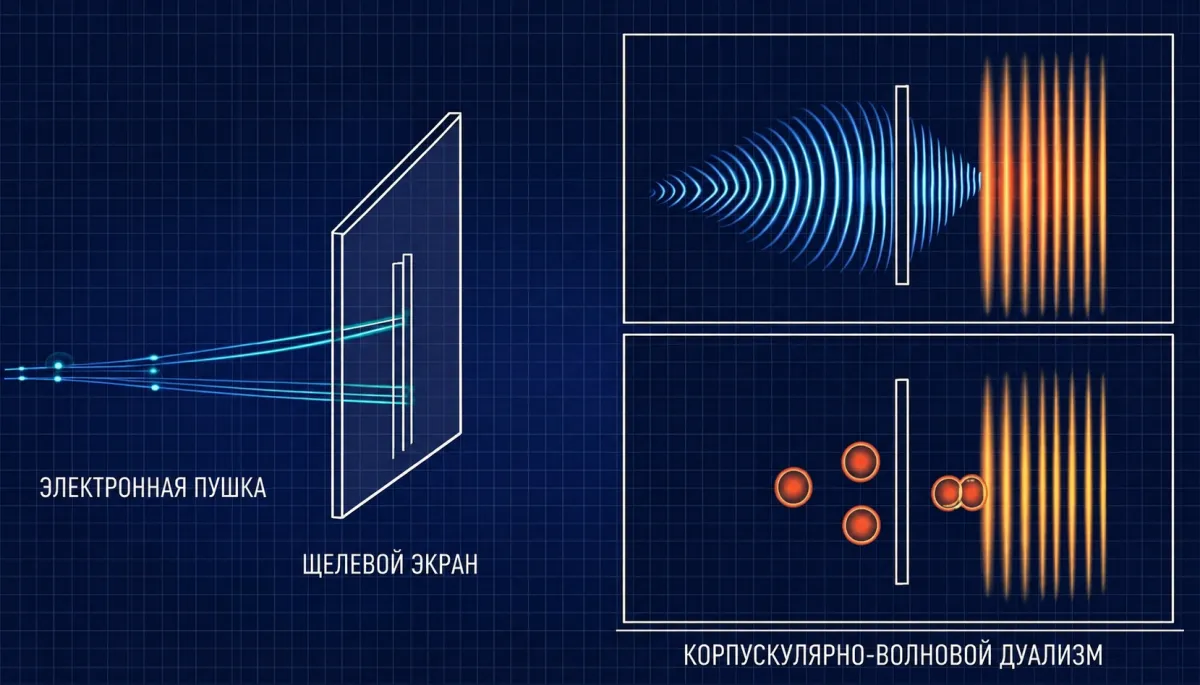
Fig. 2. Double-slit experiment. Without observation — interference (electron is a wave). With observation — the pattern disappears (electron is a particle). Reality depends on the question asked.
Reality changes depending on what question we ask the system.
John Wheeler went further. What if the decision — to observe or not — is made after the electron has already passed through the slits? Quantum mechanics answers: the result still depends on the choice made in the present. This is the delayed-choice experiment (Wheeler, 1978; realized by Jacques et al., 2007).
We do not simply observe the Universe — we participate in shaping it.
Copenhagen and the von Neumann Line
The Copenhagen interpretation claimed that the collapse of the wave function occurs upon measurement. But where does the quantum world end and the classical begin? The instrument itself consists of quantum particles. The boundary is blurred.
In 1932 John von Neumann mathematically showed that the point of collapse can be shifted along the chain all the way to the observer's consciousness. Other models later appeared (for example, Everett's many-worlds interpretation, 1957), but the very fact that mathematics permits such a shift leaves the question open.
The physicist Eugene Wigner developed this line: if a friend-observer is in superposition until the "external" observer asks him about the result — then where exactly does the reduction occur? "Wigner's friend" remains one of the deepest thought experiments in quantum mechanics.
Entanglement: Separation as Illusion
Experiments continue to confirm the strangeness of the quantum world. In 1982 Alain Aspect and colleagues experimentally demonstrated that correlations between entangled particles violate Bell's inequalities. In 2015 the Hensen group performed the first loophole-free Bell test over a distance of 1.3 km.
When two particles are born at the same point and fly apart for kilometers — a change in the state of one is instantly reflected in the other. The correlation persists regardless of distance. This is not the transmission of a signal faster than light. It is evidence that at a deep level, separation is an illusion.
The Hard Problem of Consciousness
We can scan the brain of a person looking at a red apple. The visual cortex activates, dopamine is released, the body prepares to move. But no scanner will show the sensation of redness itself — qualia, the subjective taste of experience.
The philosopher David Chalmers in 1995 formulated this as the "hard problem of consciousness": why are physical processes in the brain accompanied by subjective experience? The easy problems (how the brain integrates information, how attention works) are solvable in principle. The hard problem — why is there something it is like to feel anything at all?
Materialists (for example, Daniel Dennett) consider qualia an illusion. But if sensations are illusory — then all scientific data obtained through the sense organs are also part of the illusion. This is a logical trap from which eliminative materialism has not found a way out.
Deterministic Chaos
Classical physics does not cope even on its own field. In 1889 Henri Poincaré, working on the three-body problem, discovered deterministic chaos: in nonlinear systems, tiny changes in initial conditions lead to fundamentally unpredictable results.
The brain is one of the most complex nonlinear systems in the Universe. Even if Laplacian determinism were true, we could not physically compute the trajectory of our own consciousness.
Coda: On the Threshold
On July 14, 1930, in Berlin, Albert Einstein and Rabindranath Tagore held a dialogue. Tagore said:
"The Universe looks different when we participate in it. Science that rejects the participation of the observer is like a man who cuts off his own legs to prove he cannot walk."
Quantum physics shows: matter has no definite properties outside of interaction. Neuroscience shows: consciousness does not reduce to matter without remainder. From this — not a proof, but a direction: observation is primary.
The mechanistic picture of the world has collapsed. Laplace's demon is dead. The Universe is not a clockwork.
But what has come in its place? What does the new map of reality look like, if the old coordinates no longer work?
That is the subject of the second article.