Quantum Night — Part One
Consciousness as a fundamental part of reality, not a by-product of the brain. Ocean, drop, and the destruction of the mechanistic picture of the world — from Laplace to Wheeler and back.
Prologue
So that you understand at once where I am writing from, here is my position in four theses.
First. Consciousness is a fundamental part of reality, not a by-product of the brain. I do not prove this. I choose to see it this way.
Second. Science and philosophy describe the same reality from different sides. Their conflict is not about facts but about language.
Third. The main threat to the modern human being is the loss of subjective experience in the pursuit of measurability. I consider this more serious than climate or the economy, because climate can be survived. An unfeeling life cannot.
Fourth. We mistakenly consider ourselves separate objects, whereas we are processes within a single system. This is not a metaphor. It is a working hypothesis from which I write.
If you accept these four theses at least as a working optics, the rest of the text will work. If you do not accept them, much will fall apart, but not everything. I will indicate exactly what will fall apart in the “Objections” section at the end of the book.
Now, what is all this for.
Today the human being is a mechanism. It is surrounded by a huge number of tools in the form of communicators and applications, medicinal agents that increase efficiency the way replacing a carburetor engine with a modern fuel-injected one increases the power of a car. You have an application that counts your sleep. You have a pulse oximeter that knows when you are tired before you do. Perhaps this morning you took a drug that reduces nervousness and stimulates brain activity so that your hands do not tremble before a performance, or perhaps another drug to make it to a deadline. You optimize yourself as a system.
I write this text to show: this is not the whole truth about what you are. That you are not only a function but a node in a vast network of correlations, a byte in the stream that without you would not have happened. That the Universe, in order to be alive, needs you no less than you need it. And that optimization, taken to its end, kills the very thing for which you optimize.
In the Beginning Was the Word
In the beginning was the Word, the Bible says. This metaphor beautifully characterizes the beginning of beginnings — the Absolute Fullness. Not emptiness, not darkness, not chaos. This state cannot be imagined or described in words, because language has a point of reference and cannot characterize the foundational level. Any metaphor, any term is only a pointer to the fundamental state of reality. The Vedic rishis, the Muslim Sufis, the Kabbalists, and some quantum physicists point to the same concept: an undifferentiated field where there is neither time nor space.
There was no time for it to flow. There was no space for something to fit in. There was no motion, for motion implies a change of positions. This is a pure state in which all possible configurations exist in superposition. As the Wheeler–DeWitt equation, derived in 1967, describes, at the fundamental level time disappears. Only the network of correlations between states remains.
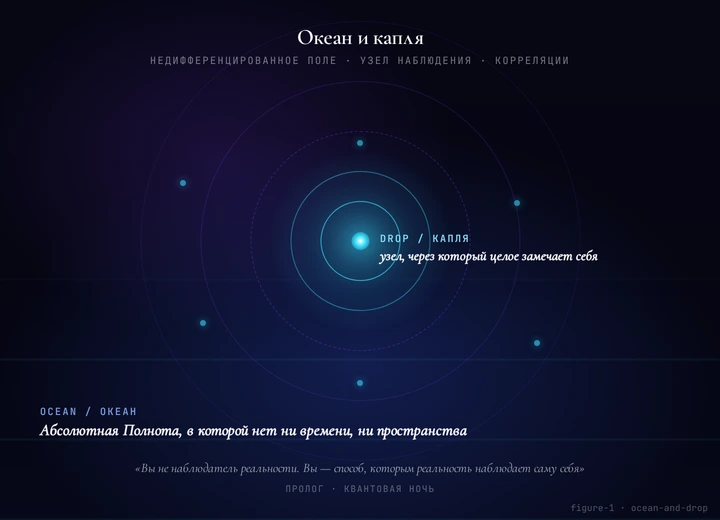
Fig. 1. Ocean and drop. The Absolute Fullness, in which there is neither time nor space, and the node of observation through which the whole notices itself.
I choose the image of the ocean. Not because it is accurate — we have no accurate description. But because it conveys the main thing: we are not the result of a breakdown, not an error in a formula. We are the way the whole notices itself. In the depths of the ocean, in absolute stillness, the ocean can know itself only through a drop. The drop is the nerve node through which the ocean knows the world, multiplying experience. The same is true of reality. A timeless field cannot know its own nature while remaining stationary. To experience dynamics, the possibility of change is needed. To understand complexity, one must consent to separation. This is the mechanism of emergence — evolution through arising states with new properties.
The first trembling is not an event in chronological time but an eternal process occurring in every quantum system. At the moment reality begins to distinguish states, the field folds for the first time. This fold is Time. Not a river flowing from past to future, but a sequence of frequency correlations necessary for stasis to experience itself as dynamics. The second fold is Space. To be “here,” one must separate “there.” This is not an empty arena but correlations between states created by the vibration of the first distinguishing. The third fold is Matter. What we call “solid” is in fact a frozen configuration: stabilized correlations of the field.
Once Einstein asked Bohr: “Do you really believe the Moon exists only when it is looked at?” Bohr replied: “No, but I cannot prove its existence without observation.” I consider this reply one of the most honest in the history of physics. The observer does not create the Moon — he participates in its stabilization as a classical object. Quantum entanglement shows that particles once interacting remain connected regardless of distance. This is not a “strangeness” of physics. It is the physical expression of correlations.
The physicist David Bohm called the Universe a holographic projection. A hologram has the property that every fragment of it contains information about the whole. Break a hologram into a thousand shards, and each shard will show information about the entire system, only with less clarity — like human DNA, in every cell of which the entire organism is recorded. Each of us is a fragment of the whole, containing information about all of reality. You are here because the system evolves. Because the fullness prior to distinction remembers the taste of dynamics, which can be understood only by passing through separation. You are not the observer of reality. You are the way reality observes itself.
When you look at the stars, you do not see distant objects. You see your own correlation. The light reaching your eyes from Sirius left it more than eight years ago. But for the fullness, where all states exist simultaneously, this light is part of your current configuration. We search for meaning, but it has always been in us. Reality is a living field in the boundless ocean of events.
This is all I wanted to say in the prologue. What follows will be slower and more detailed. But if you remember only one thought from this introduction, let it be this: you do not observe the Universe. You participate in its being.
The Destruction of the Mechanistic Picture of the World
I begin this chapter not with quantum mechanics but with Laplace. Because it is important to see what exactly was destroyed. What was destroyed was not a theory. What was destroyed was a picture of the world in which everything could be predicted given the initial conditions. And this picture, as we shall see, still lives in most of our daily decisions. In how we plan the day. In how we optimize ourselves.
At the beginning of the 19th century, Pierre-Simon Laplace, in the “Philosophical Essay on Probabilities,” wrote lines that became the manifesto of the scientific world for two centuries: “An intellect which at any given moment knew all the forces that animate nature and the mutual positions of the beings that compose it, and was sufficiently vast to submit these data to analysis, would encompass in the same formula the movements of the greatest bodies of the universe and those of the lightest atom; for it, nothing would be uncertain, and the future as well as the past would be present to its eyes.”
This demon of Laplace, the perfect predictor, became the symbol of the Enlightenment. The Universe as a clockwork mechanism, the human being as the observer of its flawless course. The scientific method, based on cause-and-effect relations, defeated mysticism. But a hundred years later Max Planck, trying to explain black-body radiation, did what he himself later called an act of scientific suicide. He assumed that energy is emitted in discrete portions — quanta. Thus began the quiet revolution that turned the mechanical Universe into a web of possibilities.
In 1801 Thomas Young conducted the first double-slit experiment, proving the wave nature of light. In the 20th century the German physicist Claus Jönsson repeated this experiment with electrons, and the world shuddered. Imagine: a gun fires electrons at a screen with two narrow slits. Behind the screen is a detector registering where the particles land. If no one observes which slits the electrons pass through, an interference pattern appears on the detector — alternating bright and dark fringes. This means that each electron behaves as a wave, passing through both slits simultaneously and interfering with itself. If a detector is placed at the slit to “look,” the pattern instantly disappears. The electrons begin to behave as particles. Reality changes depending on what question we ask.
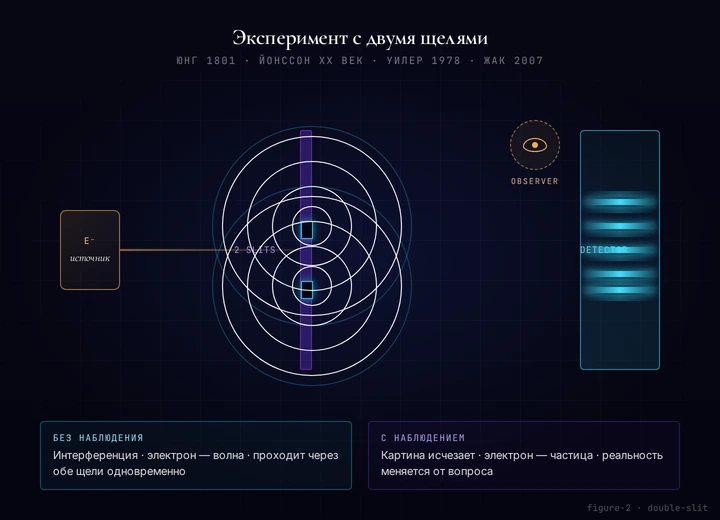
Fig. 2. Double-slit experiment. Without observation — interference (electron is a wave). With observation — the pattern disappears (electron is a particle). Reality depends on the question asked.
I remember, when I first read about this experiment, I had the sensation that someone had shifted a wall in the room I live in. The wall did not fall. The room simply became larger. Or, more precisely, it became different.
In 1978 the physicist John Wheeler devised an unexpected continuation of this experiment. What if the decision to observe the electron or not is made after it has already passed through the slits? Intuition suggests that it is too late to change the rules of the game once the game has been played. But quantum mechanics disagrees with intuition. The result still depends on the observer's choice. Not on what was earlier, but on what question is being asked now.
A careful formulation: this does not mean that the present causally affects the past in the ordinary sense. What is at issue is something else: the type of measurement chosen post-factum determines which mode of description is applicable to the system. One can describe the electron as a wave or as a particle, and the decision about which description works is made at the moment of measurement, not before it. In 2007 the group of Winfried Jacques in Brussels realized this experiment with photons. Wheeler's prediction was confirmed. Wheeler himself formulated it thus: we are not observers of the Universe, we are its co-creators.
The Copenhagen interpretation, developed by Bohr and Heisenberg, claimed that the collapse of the wave function occurs upon interaction with a classical instrument. But the instrument itself consists of quantum particles. Where does the quantum world end and the classical begin?
In 1961 Eugene Wigner proposed a thought experiment known as “Wigner's friend.” Imagine an observer placed inside an isolated laboratory. For him inside, a definite event occurs. But for the external observer the laboratory remains in superposition until he looks inside. Where does the boundary between quantum uncertainty and fixed fact run?
This problem led Hugh Everett in 1957 to the idea of the many-worlds interpretation. All possible outcomes are realized, each in its own branch of reality. I do not consider this model successful — it does not explain why in this particular branch I am now reading these lines. The problem of measure remains open. But it is a working interpretation, and I mention it honestly.
In 1932 John von Neumann, in the book “Mathematical Foundations of Quantum Mechanics,” showed that the point of collapse of the wave function can be mathematically shifted along the chain from the system to the instrument and further to the observer, up to consciousness. This is not a mathematical necessity. Other models exist, from Zurek's theory of decoherence to the objective collapse of GRW, which do not require consciousness as a fundamental element. But I believe that the possibility indicated by von Neumann is not closed to this day. And it is precisely this one that I choose as my working option.
I want to be clear here. I am not claiming that consciousness is fundamental because it has been proven. I am claiming that in modern physics there is an empty space into which consciousness, if one wishes, can be placed. I place it. You may not place it. This is a question of interpretation, not a question of fact.
Modern experiments continue to confirm the strangeness of the quantum world. In 1982 Alain Aspect and colleagues conducted an experiment confirming the violation of Bell's inequalities. When two photons are born at the same point, a change in the state of one correlates with the state of the other, even if they are separated by a large distance. In 2015 the Henson group at Delft University of Technology conducted the first loophole-free Bell test over a distance of 1.3 kilometers. This is not the transmission of information faster than light. It is an indication that quantum systems are not separated in the sense familiar to us.
In 1995 the philosopher David Chalmers posed a question that split science in two. Why does subjective experience exist at all? Why does the execution of cognitive functions not take place in the dark?
We can scan the brain of a person looking at a red apple. The visual cortex V4 is activated at a wavelength of about 700 nanometers. The limbic system releases dopamine. The motor cortex prepares the hand for movement. But no scanner will show the sensation of redness. This is qualia, the subjective taste of experience.
Daniel Dennett and Patricia Churchland argue that qualia are an illusion created by evolution. I disagree, but I understand their argument. From the fact that the content of a thought is determined, it does not follow that it is false. Truth and causality are different axes. But the paradox remains. If my sensations are an illusion, then the scientific data obtained through my sense organs are also illusory. And the very laws I have discovered turn out to be part of this illusion.
I do not consider this argument final. Dennett would reply that illusion does not mean falsity, and he would be right in his own way. But I consider this argument sufficient not to write off qualia. At least sufficient enough to keep asking the question.
The Orchestrated Objective Reduction hypothesis, proposed by Roger Penrose in the book “The Emperor's New Mind” in 1989 and developed jointly with Stuart Hameroff in 1996, offers one possible solution. Every act of consciousness, according to this model, is a reduction of the wave function in the microtubules of neurons. Qualia is the inner side of this reduction.
I present Orch OR as a working hypothesis, because it is one of the few attempts to physically explain consciousness. Most neurobiologists do not accept it; the physicist Max Tegmark in 2000 published a calculation according to which quantum coherence in the brain is destroyed too quickly. I address these objections in the third chapter. But here I make a choice: I present Orch OR not as an established fact but as a working hypothesis from which it makes sense to continue thinking.
The classic argument of materialists: the brain obeys the laws of physics, therefore all thoughts and actions are predetermined. But even in classical physics this is not true. In 1889 Henri Poincaré, working on the three-body problem, discovered deterministic chaos. In nonlinear systems, the smallest changes in initial conditions lead to unpredictable results. The brain is perhaps the most complex nonlinear system known to us.
In 2016 the physicist Matthew Fisher proposed a speculative hypothesis: the nuclei of phosphorus atoms in neurons can preserve quantum coherence due to interaction with calcium ions. This hypothesis has not yet been experimentally confirmed. I cite it as an example of the direction in which physicists are thinking, not as an established result.
Let us bring the picture together. Quantum physics shows that matter has no definite properties outside of interaction. Neuroscience shows that consciousness does not reduce to matter without remainder. I draw from this the conclusion: observation is primary. This is my philosophical choice, not a deduction from experiment. As Wolfgang Pauli wrote, it is physics and psychology that must unite into a single science of reality.
On July 14, 1930, a dialogue between Albert Einstein and Rabindranath Tagore took place in Berlin. Tagore said: “The Universe looks different when we participate in it. Science that rejects the participation of the observer is like a man who cuts off his own legs to prove he cannot walk.”
Today we stand on the threshold of a new era. An era in which physics and philosophy can unite into a single science of reality. In which every choice of ours is not an illusion but a physical act. In which the cessation of the sequence ceases to be an end, because we are part of the stationary field.