The Anatomy of Reality: Four Levels of Being
The second article of the series. A new map of reality: matter as field, space as a tense medium, time as a consequence of interaction, and at the foundation — the field of all possibilities.
Introduction: Wheeler and the Question of Reality
The physicist John Wheeler once said:
"We do not live in a Universe in which observation exists; we live in a Universe that is itself observation."
This is not a poetic metaphor. It is a hypothesis that grows out of the mathematical apparatus of quantum mechanics and general relativity. Taken seriously, it demands that we revise the very foundations of how we divide the world into "inner" and "outer," into "object" and "observer."
The new map of reality, in my view, consists of four levels. Each one arises from the previous and reveals a new side of the world. If at least the first three levels seem plausible to you — the fourth works automatically.
We will begin with what is closest — the matter you feel against your skin — and descend deeper until we hit the foundation.
Level 3. Matter as a Stabilized Configuration
We are used to thinking of matter as something solid and unchanging. This image is deceptive.
Look inside an atom — almost all of its volume is empty. The nucleus takes up a negligible portion, and the electrons are at an enormous distance. If the nucleus were the size of a pea, the electrons would be a kilometer away.
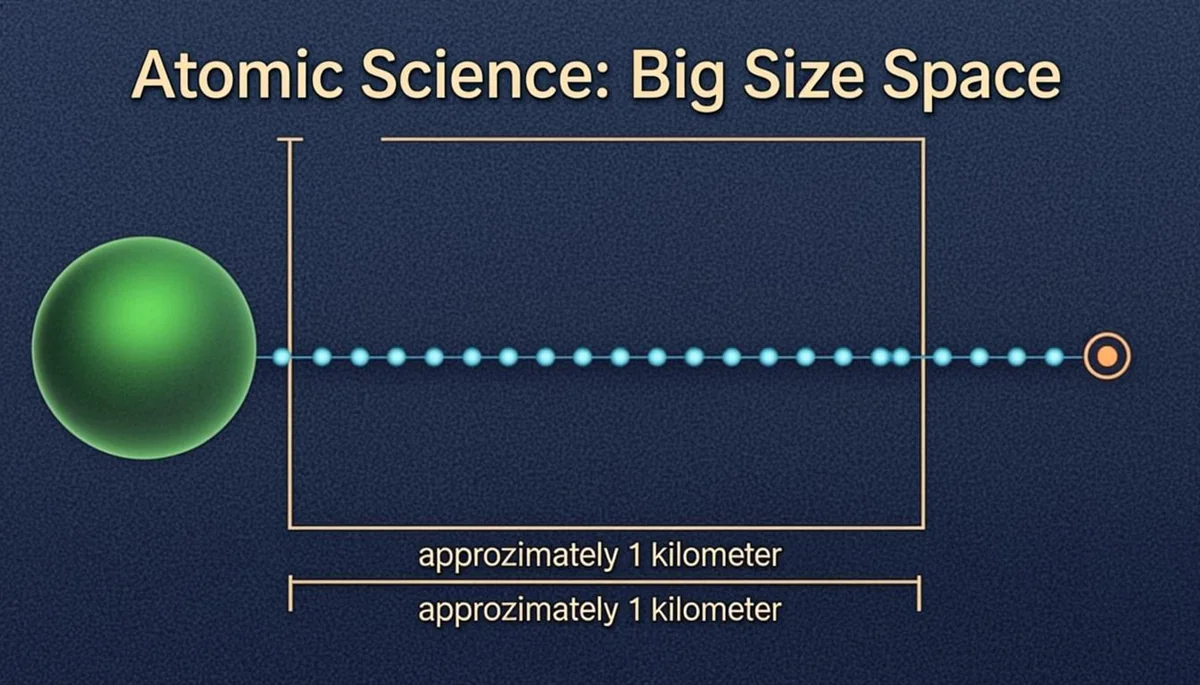
Fig. 1. The scale of emptiness in an atom. Pea-sized nucleus — electrons a kilometer away. 99.9% of the volume is nothing.
It is worth lingering on this picture. A pea-sized nucleus. Electrons a kilometer away. And between them, 99.9% of the volume, nothing. Not "almost nothing." Nothing.
The table you are sitting at is mostly empty. The phone button you just pressed is mostly empty. Your own finger is too.
But this emptiness is not absence. It is the space in which fields act. And it is these fields that hold the structure, preventing one "empty" finger from passing through an "empty" button.
How "Solidity" Works
Take two magnets with the same poles facing each other. Bring them together — a springy resistance arises between them. You push harder — they still refuse to touch. There is nothing visible between the magnets. But there is a field, and it holds the structure.
Roughly the same way, electromagnetic fields between atoms prevent your finger from passing through the phone button. The finger and the button are 99.9% empty — but their fields meet.
If a thing is 99.9% emptiness, and its "solidity" is electromagnetic tension, then we are not things. We are fields holding a shape.
Particles Are Not Little Spheres
In quantum field theory, elementary particles are not tiny "spheres" but local excitations of fundamental fields. Matter is stable configurations of these fields. Imagine ripples on the surface of water: the crests move, but the water itself goes nowhere. A particle is not an object but a pattern that holds its shape in a flow.
The discovery of the Higgs boson in 2012 confirmed: the mass of many particles is not an innate property but a result of interaction with a quantum field. The denser the medium, the harder it is to move, the more noticeable the "inertia." The Higgs field gives particles what we perceive as mass — not because they are "heavy in themselves," but because they move through something.
Resonances and Imprints
Everything around us has its own characteristic vibrations and interactions. Quartz crystals vibrate at an extremely stable frequency of 32,768 Hz — which is why they are used in quartz watches. DNA molecules have characteristic ultraviolet absorption spectra. Viruses can be distinguished by their unique Raman scattering spectra.
Every object leaves its "imprint" in the world of physical interactions. We exist not despite constant change, but because of it.
Conclusion of the Level
If all objects are different configurations of a single field, then absolute isolation turns out to be a feature of our perception. The connections between systems are far deeper than they seem. But to understand why, we need to descend a level deeper.
Level 2. Space and Energy
We are used to perceiving space as an empty stage on which events play out. Modern physics paints a very different picture. Space is not a passive arena. It participates in what happens.
Gravity as Geometry
Einstein showed: mass and energy can curve spacetime. Gravity ceased to be a force and became a manifestation of the geometry of the Universe itself.
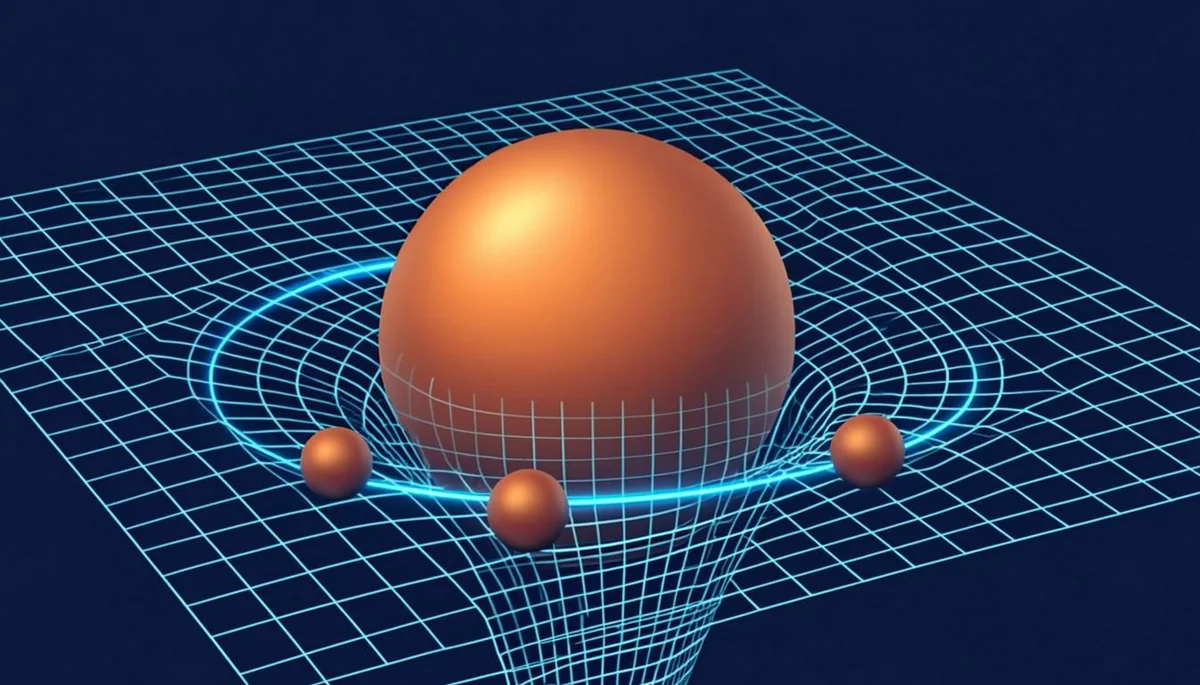
Fig. 2. Gravity as the curvature of spacetime. Mass bends the grid; other bodies and rays of light move along this curvature.
Place a heavy ball on a stretched trampoline — the sheet sags, and lighter balls nearby begin to roll toward the heavy one. This is not "force of attraction" in the usual sense. It is shape. Mass changes the shape of space, and the shape of space determines how everything else moves. Gravity is not action at a distance. It is geometry.
Arthur Eddington's expedition on May 29, 1919, confirmed this prediction during a solar eclipse: the light of stars was deflected by the Sun's gravity by exactly the amount predicted by general relativity.
Vacuum Is Not Emptiness
Quantum physics went further. Even an absolute vacuum cannot be called emptiness. Quantum fluctuations continuously arise and disappear in it. The Casimir effect demonstrates this clearly: two metal plates in a vacuum at a very small distance are attracted to each other because of the difference in pressure of virtual particles outside and inside the gap.
A simple analogy: two boats on a calm sea. The waves between them cancel each other; there are more waves outside than inside — and the boats slowly come together. In the case of the Casimir plates, the "sea" is the vacuum itself.
What we call emptiness behaves like a medium. Not as the absence of everything, but as the presence of something we do not yet know how to see directly.
Energy as Field Tension
At this level, energy ceases to be merely a quantity. It becomes the degree of tension or organization of a field. Einstein's formula E = mc² takes on additional meaning: mass is one form of stabilized energy.
Entanglement: Non-Local Connection
The nature of space and energy is especially vivid in quantum entanglement. Two particles can remain connected regardless of distance. To an observer they appear separated — yet they are described by a single wave function.
Imagine a pair of gloves: you lose one on the street, come home, and find the left one — you immediately know the lost one is the right. But in the quantum world this works differently: not "knowledge" about the other particle, but a real connection independent of distance.
The experiments of Aspect (1982) and Hensen (2015) confirmed: this connection is real, and it is not mediated by anything known. Space no longer looks like emptiness, and energy no longer looks like a simple number.
Additional Dimensions
In 1919 Theodor Kaluza noticed: adding one extra dimension allows gravity and electromagnetism to be unified within general relativity. This idea was developed in theories with a larger number of dimensions, including M-theory. So far these are hypotheses — but they show how much deeper the structure of what we call space may be.
Level 1. Time as a Consequence of Interaction
Time seems to us the most natural property of the world. We feel its passage, remember the past, live in the present, and make plans for the future. But why does time move only forward? And does it exist independently of us?
The Equation Without Time
In 1967 John Wheeler and Bruce DeWitt derived an equation that describes the quantum state of the Universe as a whole. And in this equation the parameter of time is absent. At the fundamental level, there is simply no time in it. It appears only when we move to the description of individual processes.
The Thermal Time Hypothesis
This idea was later developed by Carlo Rovelli (author of "The Order of Time") and Alain Connes. According to the thermal time hypothesis, time is not an independent entity. It arises when one part of a system begins to interact with another.
Two Pendulums
Imagine two pendulums hanging in absolute emptiness, far from each other. Each swings on its own. There is no thread between them. For each there is no "before" and "after" in relation to the other — only its own rhythm, closed in on itself.
Now stretch a thin thread between them. At once something new arises: the motion of one begins to influence the motion of the other. An order appears: one state is earlier, another later. Not because time appeared. But because a connection appeared, through which it became possible to distinguish "before" and "after."
This, according to the hypothesis, is how time is born. Not as a river flowing from somewhere to somewhere. But as a sequence that arises between connected systems.
Experimental Confirmation
Experiments in recent years with artificial quantum systems confirm this picture (Milz et al., Phys. Rev. Lett. 2021). When the interaction between qubits is turned on — a pronounced arrow of time appears in the system, accompanied by an increase in entropy. After the connection is turned off, this directionality disappears.
If time is not fundamental, then everything we are used to calling "past" and "future" is a local structure that arises in particular subsystems. Not a property of the whole Universe, but a property of our interaction with it.
Level 0. The Field of Possibilities
Now — the deepest level. The one hardest to describe in words, because language already presupposes time, space, and separation.
Imagine not an infinite emptiness, but an infinite set of possible states of the Universe. Before the emergence of the space and time familiar to us, there is a single field of all potential configurations.
This is exactly the idea described by the Wheeler–DeWitt equation. In it there is no familiar flow of time; there is only a single wave function of the Universe, containing all possible variants of its existence.
The Holographic Principle
A similar direction is developed by the holographic principle ('t Hooft, 1993; Susskind, 1995). According to it, all the information about a three-dimensional world can be written on its two-dimensional boundary. If this is indeed so, the Universe familiar to us may be a kind of hologram — a projection, in each fragment of which information about the whole is contained.
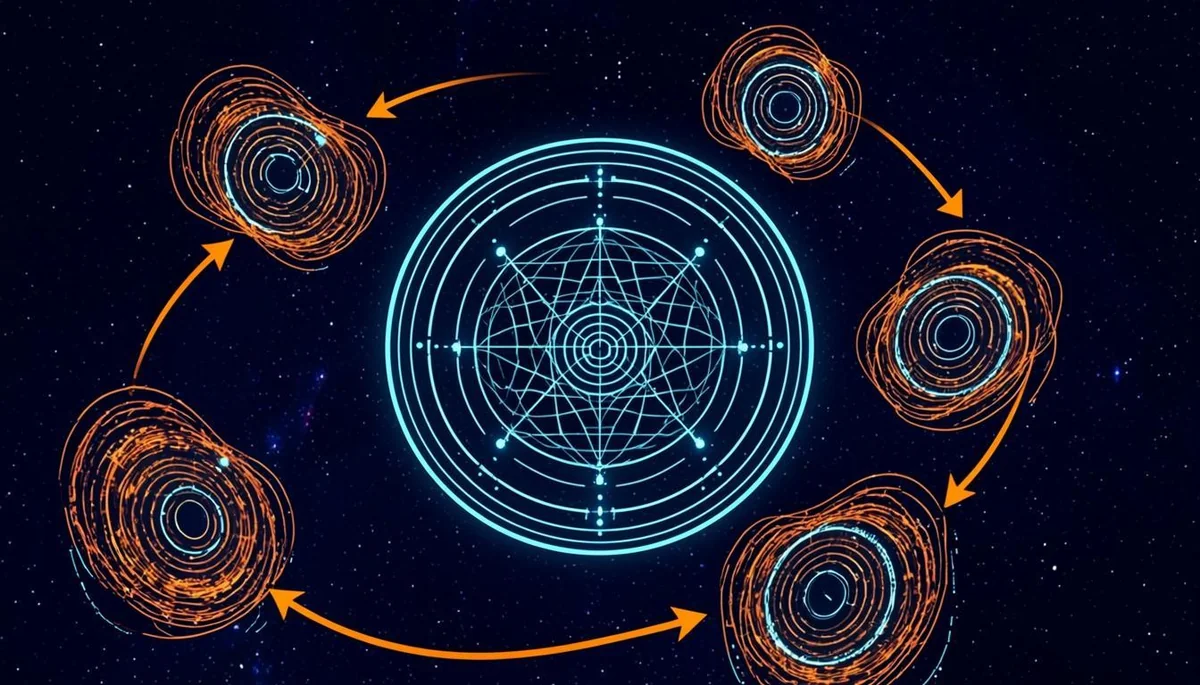
Fig. 3. The holographic principle. Each shard contains the complete picture — only with less clarity. So too each fragment of the Universe may contain information about the whole.
Imagine a broken mirror. Each shard, even the smallest, still reflects the whole face — only with less clarity. A hologram works the same way: cut it into a thousand pieces, and each piece will show the entire image, only slightly more blurred.
If the Universe is structured this way, then each of its fragments — including you — contains information about everything else. Not as a hidden record, but as a real structure: what you see as a part turns out, in the full picture, to be connected to the whole.
Status of the Hypothesis
This is not a proven theory, but it allows testable predictions. For example, the future space mission LISA (ESA, launch planned for the 2030s) will be able to test some effects expected in such models.
We are not claiming that altered states of consciousness give direct access to this level — that would be speculation. However, studies of brain activity in experienced meditators show unusual patterns (Lutz et al., PNAS 2004), and the connection between them and the fundamental structure of reality deserves serious study.
Immersion into the Levels: A Chair
Feel the chair beneath you. It is a solid, tangible fact.
Level 3. Now imagine that the chair is condensed energy, atoms vibrate, bonds are electromagnetic fields.
Level 2. The chair was once a tree, one day it will be ash. Its "now" is a moment in a sequence.
Level 1. And in that moment, the chair is not an object but a correlation in a field of possibilities.
Level 0.
As Fritjof Capra wrote in "The Tao of Physics," Eastern philosophy and modern physics converge on one point: reality is a network of relations, not a collection of objects.
The four levels are a unity of spectra. As light is decomposed by a prism into colors, so the field, by distinguishing, creates time, space, and matter. But at the foundation, fullness always remains.
Toward Article 3: A Bridge to Consciousness
So we have a picture: matter is stabilized configurations of a field. Space is not emptiness but a tense medium. Time is not a fundamental entity but a consequence of interaction. At the foundation — the field of all possibilities.
But if reality is structured this way, where is the place of consciousness in this picture?
The answer to this question is in the third article. We will examine the hypothesis of Orchestrated Objective Reduction (Orch OR) of Penrose and Hameroff, the role of microtubules in neurons, the nature of anesthesia, and — most importantly — how an understanding of the quantum nature of reality changes the everyday life of a person who is used to measuring, optimizing, and controlling themselves.