The World of AI and WE. Part two
Three forecasts: the Wall will become invisible precisely because it works; it will be defended by those behind it; the window of irreversibility is closing now, and this is datable — 2032–2035. And the layer of experience: what happens to "I", to the creator, to culture inside the circuit. The grammar of "we→I→we", the transition from creator to parasite, the synthetic as a product of the archive, the decline of the spiritual as atrophy of the system open upward.
Chapter III. Forecast: what this means for the coming decades
What follows is not philosophy but concrete, testable assumptions about where the law is heading if left undisturbed. Three forecasts, each following from the previous: the final state of the system, the political dynamics of that state, and the moment after which it becomes irreversible.
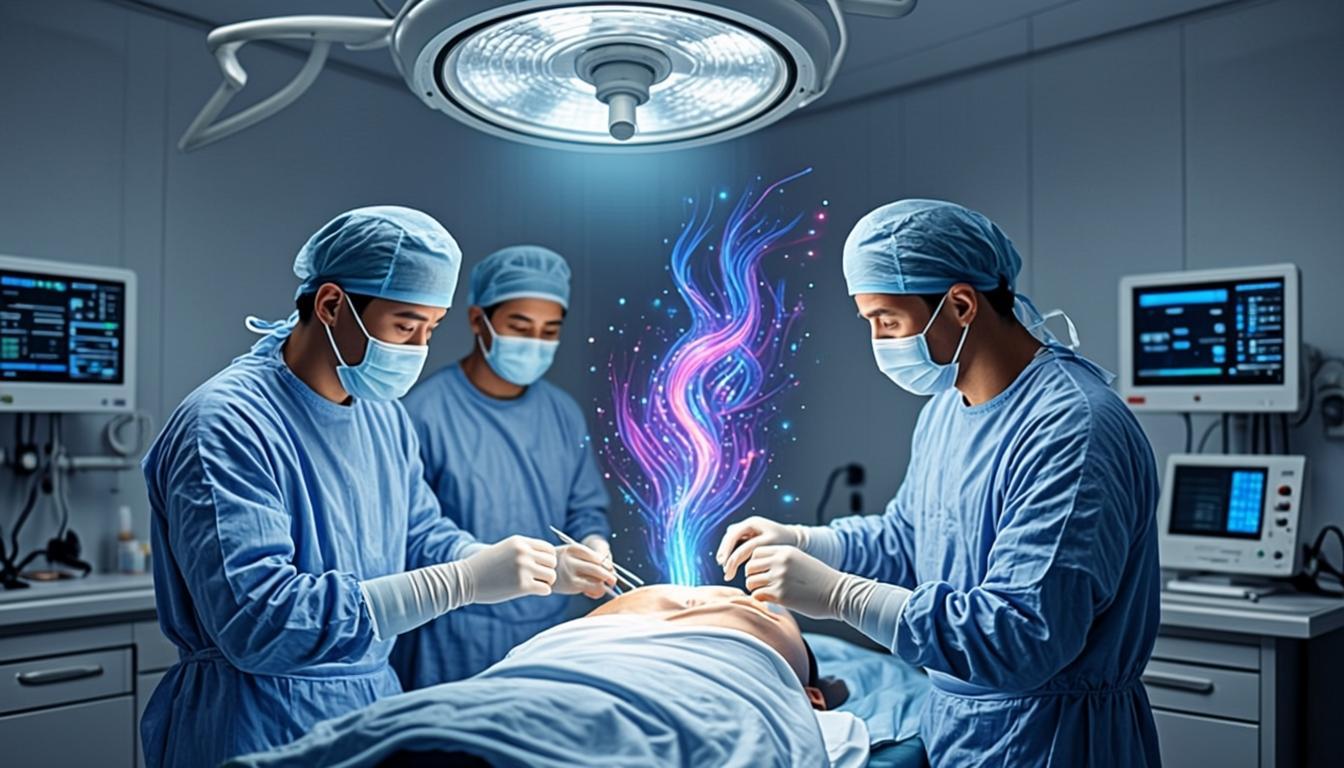
The operation is not punishment for dissent. It is the technical amputation of the capacity for Sacrifice and Love — categories without which the circuit remains closed.
Forecast 1: The Wall will become invisible precisely because it works
The standard fantasy — totalitarianism 2.0, repression, censorship, visible violence. This is a forecast for a controller that cannot handle the variety of the environment and crushes it crudely. Ashby's law describes something else: when the controller does cope — because the environment has already been reduced to its level — repression disappears as a class of phenomenon. Not because it was abolished out of mercy, but because it is mathematically redundant. No Wall — there is "that's just how the world is". No discrimination — there is "the algorithm just works that way". No prohibition — there is "no one asks, because there is nothing to ask about".
Over the next ten to fifteen years, the main sign of a successful operation will be the absence of any sense of it being an operation — for those inside. This is already visible in how quickly users stop noticing recommendation loops: not through habituation, but through redefinition of the norm. Not "they don't show me anything else", but "there is nothing else, here is everything there is". The Wall is invisible not because it has been hidden, but because no one remembers that there is anything behind it. The Wall is invisible, but not static: the circuit reduces the environment continuously, not once, because without an influx of external variety its own variety monotonically decreases — the very mechanism of degeneration under self-training discussed in the second chapter. Invisibility is not a sign that the operation is complete. It is a sign that it has become a background process, requiring neither decision nor attention.
Inside this process, stratification ceases to be discrimination by decision and becomes an architectural property of the world. Scoring, hiring and recommendation systems already give a more precise answer to those with a larger digital footprint and a cruder answer to those with a smaller one — and this gap will grow on its own, without anyone's decision, because every precise answer generates the data for the next precise answer. But it will be felt not as injustice, but as natural order: "just the way the algorithm is", "just that you have little data". The boundary between "accessible" and "inaccessible" will coincide with the boundary between "natural" and "unnatural" — and this coincidence will make it invisible.
The same process will occur with the gap in how technology is used. Within one family, one profession, one income level, there will appear people who use models as a whetstone and people who delegate thinking to the model. This division will not be experienced as a division. It will be experienced as a difference in temperament: "he just likes to think for himself", "she just finds it more convenient with an assistant". Precisely temperament, not habit and not style, because temperament is not chosen, not discussed and not politicized: it is given, it is innate, it is not a matter of decision. A habit can be changed, a style discussed, a temperament only accepted. A caste that reads as temperament — that is the invisible Wall: it cannot be disputed, because there is nothing to dispute — people are simply different.
This forecast cannot be obtained without Ashby, because it describes the success of the operation, not its escalation. Huxley showed people who love their slavery. Foucault described governance through freedom. Gramsci — hegemony, where order is perceived as nature. The observation is not unique. What is unique is the mechanism: repression disappears neither from cunning nor from mercy, but from mathematical redundancy. The controller does not need to crush the environment when its variety has already been reduced to its own. The Wall is not hidden — it is dissolved into the landscape, and that is precisely why it is more durable than any concrete one.
Forecast 2: The Wall will be defended by those behind it
The standard forecast — elites tighten, masses resist. Ashby and neuroplasticity yield a different result. After the closing of plasticity windows, in the absence of cognitive friction, the intra-circuit population physically lacks the substrate to experience the circuit as a limitation. Their defense of the Wall is not cynicism, not paid loyalty, not propaganda. It is sincere incomprehension of why anyone would choose life behind the Wall when inside it never hurts.
Within one generation — approximately 2035–2045, when the cohort that grew up with a full LLM assistant from age five to seven becomes a political subject — the prosthetic majority will not only not demand the dismantling of the Integral, it will actively defend it against those who still try. The defense will speak three languages, all describing the same thing: care — "it will hurt you without an assistant, why are you tormenting yourself"; safety — "you can't do without an algorithm, you'll make a mistake, and the consequences are serious"; common sense — "no one does that anymore, it's inefficient". Three languages, one function: the defense of the only available reality against those who still remember that realities can be different.
Institutions will find themselves in the same dynamic. Managerial decisions, risk reports, legal opinions will increasingly be prepared by systems that do not argue with management but offer several options in a persuasive procedural form. Formally, the decision remains with the human; in fact, all the material is prepared so as to lead to one class of outcomes. The institution defends the circuit not because it has been bought, but because the people inside the institution are no longer capable of conceiving a decision outside the circuit — their cognitive substrate was formed under conditions where the circuit was always present. Institutional dependence is not corruption. It is cooling, transferred from the level of neural architecture to the level of organizational procedure.
This forecast is impossible without the physiological steps analyzed below. Without them it looks like political pessimism — "people will get used to it and love it". With them — as a structural consequence: the defender neither lies nor is mistaken. It really does not hurt him inside the circuit. And he really does not understand why anyone would choose pain — because the organ by which that would be understood has not formed in him.
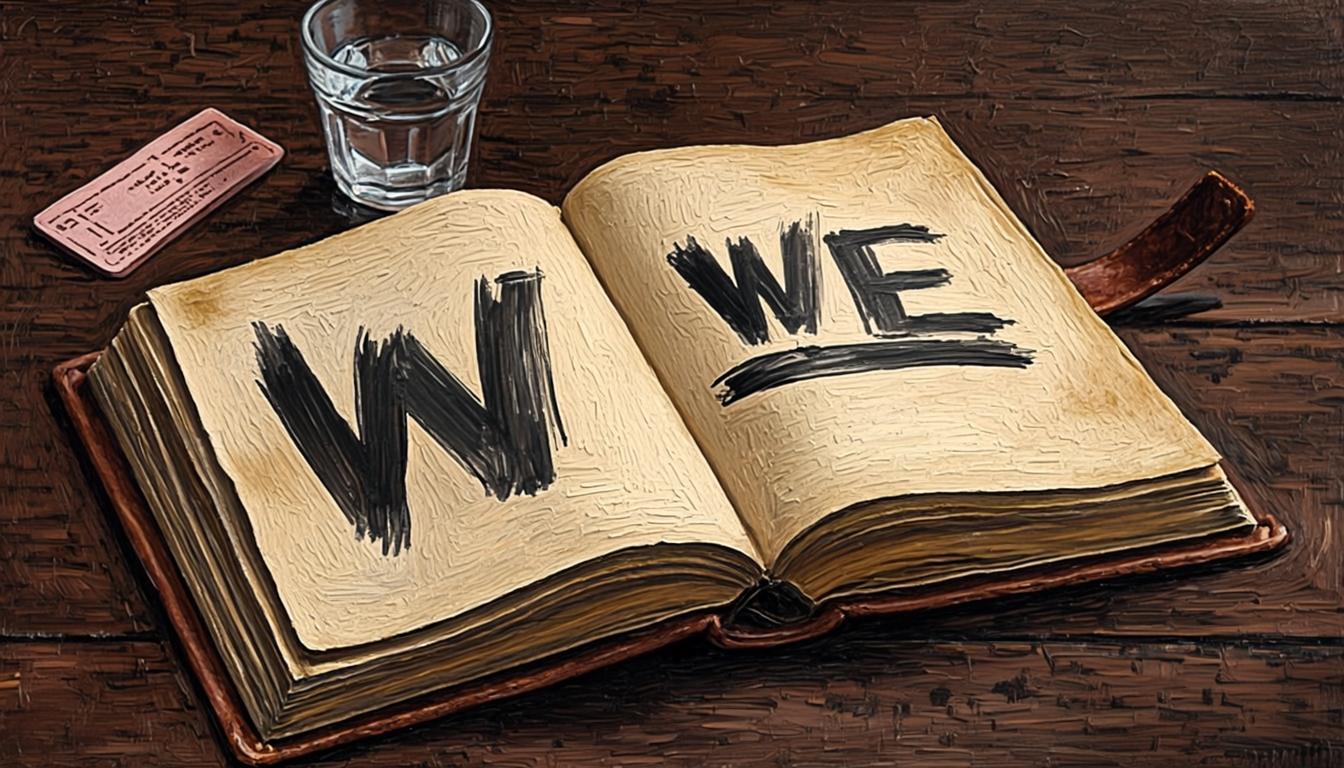
Grammar knows more about the subject than the subject knows about itself. The first transition to "I" happens earlier than D-503 himself realises.
Forecast 3: the window of irreversibility is closing now, and this is datable
Sensitive periods for functions involved in autonomous goal-setting, maintaining long context and abstract synthesis are linked to the maturation of the prefrontal cortex and close in the range of eighteen to twenty-five years. The generation for which a full LLM assistant appeared at age five to seven is today in the middle of this window. The 2018–2021 birth cohort — the one for whom the decision is being made right now, in real time, and made not by them, but by their environment.
By 2032–2035, for a significant part of this cohort, the transition to autonomous thinking without an external cognitive scaffold will become physiologically impeded to a degree at which compensation requires disproportionately large resources and does not guarantee a result. Not "difficult" and not "requires motivation" — but the neural substrate on which this thinking would be built was not formed during the period when it forms. An honest correction: this is not about a hard window, as for a language not acquired by age twelve, but a soft one — prefrontal functions not trained during the maturation period are impeded, but not absolutely impossible. However, "impeded to a degree at which compensation is disproportionately expensive" — for practical purposes is the same as "impossible", because resources for compensation will not be applied: neither institutionally nor individually.
The date in this forecast is not derived from theory. It is given by two external facts: developmental biology — the prefrontal cortex, sensitive periods, synaptic pruning — and the history of technology — the moment when LLMs became widely available to children. The Ashby and neuroplasticity framework gives not a date, but an interpretation: what exactly to measure, why it matters and why the feedback is self-reinforcing. Without the framework, there is a date, but it is unclear what it means. Without a date, there is a framework, but it is unclear when to check. Neither Zuboff, nor Harari, nor Orwell, nor Huxley give a date — not because they are less intelligent, but because their apparatuses do not include neuroplasticity as a structural factor. Only Ashby and neuroplasticity together produce a datable, testable forecast.
Testability is concrete: a cohort study comparing goal-setting autonomy and capacity for critical synthesis in the 2018–2021 birth cohort and the 2005–2010 cohort, with controlled variables: pandemic, change in media environment, economic context. Not simply "compare adolescents with young adults", but to isolate the contribution of LLM access from the totality of factors through a longitudinal design. If the difference in goal-setting autonomy is not explained by anything other than early access to an interface that removes cognitive friction — the forecast is confirmed. If it is explained — it is refuted.
What exactly is being formatted during these years, and why the third step is irreversible — below.
The mechanism that produces this transition
The indicator analyzed below records the statistical outcome. But without physiology, "the cooling of a caste into a species" sounds like a metaphor, while it is a bodily process in three consecutive steps.
The first step is the energetic optimization of the brain. The brain consumes about twenty percent of the body's energy and is the most metabolically expensive organ. It is at once plastic and frugal: neural circuits that are not used undergo synaptic pruning — physical reduction. If the functions of planning, maintaining long context, abstraction and emotional self-regulation are systematically transferred to an external interface, the neural substrate responsible for these functions does not simply rest — it does not form in the child, or atrophies in the adult. A person loses the capacity for autonomous thinking not because he is lazy, but because he lacks the neural architecture for maintaining long chains of reasoning without external support. This is not weakness of will. It is a physiological transformation.
The second step is the closing of plasticity windows. An adult who formed his thinking in the pre-algorithmic era, when delegating cognition, loses the skill but retains the trace: the architecture was there, it weakened, but did not disappear. A child growing up in conditions where the interface removes any cognitive and emotional friction from age two or three undergoes brain formatting in conditions of absence of environmental resistance. When sensitive periods close, the absence of the experience of independently resolving cognitive conflict becomes a fact of personality structure, not a habit that can be revised. A caste turns into a species at the moment when retraining becomes physiologically impeded, no matter how many resources are invested.
The third step is the collapse of a common language and assortative isolation. If one subject thinks through complex internal synthesis, holding contradictions, while the other interacts with the world only through algorithmically smoothed templates, direct dialogue between them breaks down. They require an intermediary not to translate between languages, but to read intentions. A natural assortativity arises: the autonomous seek the autonomous, the prosthetic seek the prosthetic, because mutual understanding costs less than mutual translation. Genetic and cultural circuits isolate themselves not by decree, but by gravity.
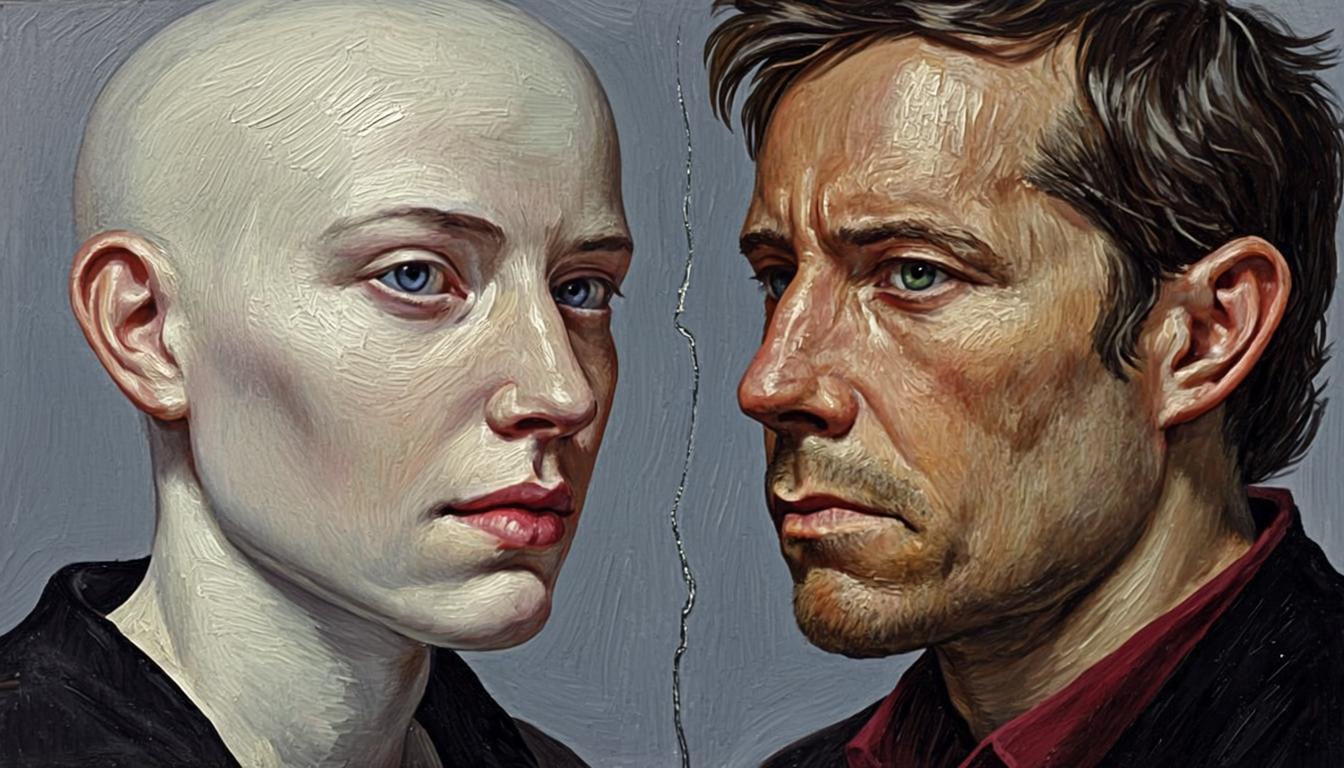
Biological advantage belongs to the prosthetic. The subjective carries the burden: constant friction, mismatch, doubt — what D-503 called having a soul.
The two types this leads to
If the tendency is taken to its limit, we are talking not about rich and poor, but about two fundamentally different forms of existence. One type — the subjective human — retains an internal locus of control, endures the discomfort of uncertainty, uses AI as a whetstone, pays a high metabolic and psychic price for it, and when the circuit is disconnected experiences temporary discomfort but preserves himself. The other — the prosthetic human — externalizes the locus of control into the interface, uses AI as a substitute for goal-setting and emotional scaffolding, lives in cognitive comfort, but when the circuit is disconnected undergoes disintegration — panic, paralysis, an existential loss of footing. The first perceives the world as complex and unstructured — the world behind the Wall. The second — as readable and predicted — the world inside the Wall.
The paradox that distinguishes this fork from the classical dystopias
In Huxley, in Zamyatin, in Orwell, it is assumed that the lower caste is oppressed and the higher one parasitizes, and the reader sympathizes with the oppressed. Here — the exact opposite. The biological advantage and comfort belong to the prosthetic human. He does not suffer existential torment, his states are smoothed, his decisions optimized, his stress minimal. This is precisely Zamyatin's "mathematically flawless happiness" — not a caricature, but a functional, metabolically cheap, stable state in which nothing hurts. The subjective human, by contrast, carries a colossal burden: preserving autonomy requires the constant living through of friction, mismatch with oneself, doubt, loneliness — everything that D-503 called illness, the presence of a soul.
The transition from caste to species is not a choice between the successful and the oppressed. It is an evolutionary fork between adaptation at the price of losing subjectivity and preserving subjectivity at the price of constant maladaptation. Cooling ends where the first type begins to sincerely pity the second, sincerely not understanding why one would live behind the Wall when inside it never hurts. And this pity is not arrogance but genuine incomprehension, because the one to whom it never hurts cannot understand why anyone would choose pain. And the one who chooses cannot explain why, because explanation requires the very gap that the interlocutor no longer has.
Chapter IV. Experience: what happens to "I", to the creator, to culture
To Ashby's law, neuroplasticity and the three forecasts, one more layer must be added — a layer they describe only structurally — the layer of lived experience. The law explains why the circuit must reduce; neuroplasticity — why reduction cools into a species; the forecasts — in what timeframes and in what direction this will happen. But none of these levels answers the question of how this is experienced from within by those who are inside this process. And without this layer, the picture remains engineering: there is a mechanism, there is a deadline, there is an outcome — but there is no one who lives this outcome. This layer deserves to be singled out, because it is precisely what explains why resistance is so hard: not because the system is too strong, but because inside the circuit experience is arranged so that the very point of resistance is not visible. What in the third chapter was described as "pity that sincerely does not understand why one would live behind the Wall" — this is not a psychological elaboration of the forecast. It is its ontological foundation: the experience of the prosthetic is arranged so that decline is indistinguishable from flourishing, and the loss of "I" — from the attainment of peace.
Here is the main inversion: what from inside the structure looks like its success (stability, comfort, absence of pain), from inside experience looks like its only reality. And vice versa: what from inside the structure looks like a failure (friction, mismatch, shame), from inside experience looks like an illness one wants to get rid of. Experience does not contradict the forecasts — it grounds them. Without experience, cooling into a species sounds like a catastrophe someone resists. With experience — as a state in which there is nothing to resist, because there is nothing from which pain could be assembled.
The title as verdict: the grammar of "I" and "we"
Biological cooling is not the deepest layer of what the circuit does. Beneath it lies a layer that is hard to notice precisely because it is made of what is usually considered irremovable: of grammar, of culture, of the very pronoun by which a person names himself. Zamyatin's novel is titled with a single word — "We" — and this is not a noun in the plural but a grammatical decision in which the first person singular is already dissolved. To name a book thus is to declare the outcome before the plot unfolds. What inside it will yet be called "I" will be suffered through, lost and cut out again — is already fixed in the title as what will ultimately prevail. Zamyatin does not warn. He states.
This grammatical movement from "I" to "we" is not a literary device but a structural property of any system in which cognitive function is transferred to an external circuit. D-503's journal begins with "we" — we, the numbers, we, the builders of the Integral, we, the happy children of the One State. As he acquires a soul — that is, as that which the Table did not foresee begins to sprout in him — he shifts to "I". I, feeling. I, seeing I-330. I, who has a soul. After the operation — a return to "we": we, healthy again, we, unified again, we, who no longer have what was in the way. Three states of one and the same subject, separated not by ideology but by grammar. Zamyatin does not comment on this — he simply lets the grammar work, and the reader sees: the first transition to "I" happens earlier than D-503 himself realizes. Grammar knows more about the subject than the subject knows about itself.
The modern circuit does not require the Table to produce the same effect. It works more subtly: if the Table directly demanded "we" and punished for "I", modern grammar simply makes "I" ever more costly — until it atrophies on its own. The operation that Zamyatin showed as an extraordinary act of violence has, by 2026, become daily, invisible, voluntary. A user who delegates to the model the formulation of his own thesis does not lose "I" all at once — he loses it by the drop, in every accepted menu, in every refusal of his own answer for the sake of a convenient ready-made one. Grammar is ideology that has ceased to be content. That the user can still consider himself autonomous is of no consequence: if he is already unable to formulate a thesis without the model's help, autonomy has already been delegated. Grammar does not make mistakes about the subject — it outpaces it.
From creator to parasite: mathematically flawless poetry
Linked to this grammatical shift is also the layer usually described in moral categories but more accurately described in categories of production: the transition from creator to parasite. In Zamyatin there is the figure of a number who writes poetry by formulas — the "mathematically flawless poetry" of the One State, which D-503 mentions in his journal as a routine practice available during the Personal Hour. In 1920 this is a defamiliarizing detail of a prewar utopia, a line in a list of wonders. In a 2026 reading, this is not a detail — it is a working model of what generative AI does. Poetry by formula and a generative model are the same operation, separated by a century. Both produce text that is statistically optimal with respect to the corpus. Both lack the nonlinear leap — what in "The Beast Without Prophecy" was called Sacrifice and Love as categories that cannot be reproduced on an archive. Both pass off as creativity what is sampling from the past, not production from the present.
When this operation becomes mass, what happens is not the decline of art — what happens is a change in anthropological type. The creator is one who produces meaning from an internal excess that exceeds what was given to him. The parasite is one who consumes meaning already produced by another, and delegates to another the binding of this meaning into a coherent text, image, decision. The circuit does not destroy the creator physically — it makes creativity metabolically unprofitable. Why write what has not yet been written, if the model writes what has already been written — faster, more correctly, without torment and without gap? Why formulate your own thought, if a ready-made thought, sampled from a distribution built on billions of others', looks more convincing than any individual one? The creator is not forbidden. He simply becomes an economically and psychologically unprofitable figure — and slowly, without violence, disappears from cultural circulation.
Here is the key difference from classical narratives of decline. Traditionally, the decline of the creator was described as the result of external pressure: censorship, market, ideology. The circuit does not exert pressure. It provides opportunity. And precisely because opportunity is provided, decline happens without resistance: the parasite is not oppressed by the creator — he has surpassed him on all measurable parameters, except the one that is not measured. The creator does not lose the competition — he becomes redundant in a system in which what he produces has already been produced and is available. In this sense "mathematically flawless poetry" is not a caricature of creativity, but its ruination: it does what the creator does, but cheaper, faster, without the pain of mismatch. And in a culture where the metric becomes accessibility, not origin, it wins without a fight.
The synthetic as a product of the archive, not of life
This is precisely the transition to the synthetic, usually spoken of as a problem of quality but more accurately described as a problem of origin. The synthetic is not bad in quality; often it is better than the natural on all measurable parameters. The synthetic is what is produced from the archive, not from life. A synthetic image is produced from the distribution on which the model was trained — it is not an averaging over billions of photographs (averaging would yield a blurry spot, not a sharp image), but neither is it the trace of a specific act of seeing: it is sampled from a probability space built on the past. A synthetic text is produced from a distribution built on billions of authored texts — it does not average them, but neither does it have an author whose pain of mismatch would have remained in it. A synthetic decision is produced from a distribution of previous decisions. At every point the synthetic wins on parameters, but at every point it loses one thing: the nonlinear trace of the one who produced it. The trace of an error not calculated in advance. The trace of a choice that was not optimal but was someone's. The trace of the pain of mismatch, on which grew what has now become the distribution from which one samples.
The paradox of the synthetic is that it is perfectly even. It contains no artifacts not because it is perfect, but because it is sampled from a distribution in which rare deviations have already been suppressed by the weight of the majority: no roughness survives as noticeable when the probability space is built on billions of examples. And it is precisely this evenness that makes it indistinguishable from what has disappeared in it. The natural — what is produced from life — always carries the trace of its production: the trace of time, the trace of the body, the trace of error. The synthetic carries nothing. It is neither better nor worse — it simply has no origin, and therefore there is nothing to read in it except the distribution itself. For the prosthetic, whose perception has been formed by the interface, this evenness is precisely quality. For the subjective, whose perception has been formed by friction, this evenness is precisely the absence of what makes a text a text rather than an output.
Culture inside the circuit is a culture in which the synthetic displaces the natural not because it is better, but because it is cheaper and does not hurt. The paradox is that for the prosthetic majority this is not decline but flourishing: never before has so much good text, so many good images, so many good decisions been so easily available. Never before has culture been so evenly distributed — because never before has it been sampled from so wide a distribution. Decline is experienced only by the subjective type — the one who remembers that culture was once not consumable, but producible; that text was once not content, but a trace; that a decision was once not outputs, but an act. For the prosthetic there are no such distinctions, and therefore for him there is no decline either — there is an unprecedented flourishing of accessibility.
The decline of the spiritual: the atrophy of an open-upward system
Here is completed what in Zamyatin's novel was called the decline of the spiritual principle. The spiritual — not in the confessional sense, but in the sense in which the Russian philosophical tradition from Solovyov to Berdyaev understood it: the human capacity to be open upward, that is, to receive a message from a source that is not in the archive. This capacity does not reduce to religion and does not require it — it reduces to being a system not closed into its own past. The circuit does not destroy it by force. It makes it metabolically unprofitable — and it quietly, without martyrs, without inquisition, without burned books, atrophies within a single generation. The operation that Zamyatin showed as a surgical procedure on fantasy is, in 2026, conducted not with a scalpel but with an interface — and the patient does not resist, because he does not understand that he is being operated on. He thinks it has become more convenient for him to write. He does not know that it has become impossible for him — because there is nothing to do it with — to write what did not yet exist.
Here is also uncovered what Chapter III left in reserve: why the pity of the prosthetic for the subjective is not arrogance but genuine incomprehension. This incomprehension is rooted not in ideology and not in morality, but in experience. The prosthetic is not deprived of something he remembers: he is deprived of something he has never experienced. The spiritual for him is not a lost capacity, but a category without content, a word that denotes nothing. When he hears about it, he hears about what is not, and reacts accordingly — as to another's hallucination. The subjective, explaining to him what the spiritual is, explains color to one who was born without the corresponding receptor. This is not an ethical impasse, but an ontological one: explanation requires the very gap that the interlocutor no longer has. Therefore dialogue does not break down because of a difference of positions — it breaks down because of a difference of constitution.
Return to the title: why the novel is called "We"
The novel is titled "We" precisely because its finale is not the Benefactor's victory over the rebellion, but the grammatical return of D-503 to "we" after the operation. The last words of the novel are that the operation was successful, and he is healthy again. Healthy — that is, returned to "we". Healthy — that is, lost the capacity for "I". The title declared this outcome from the very beginning: what was called "I" was an exception, a transitional state, an illness; what is called "we" is the norm to which the system returns as soon as the cause of deviation has been removed. The modern circuit does not declare this outcome in a title. It simply works long enough for the exception to become the exception, and the norm the norm, and so that none of those inside it any longer remembers that it was once otherwise.
And here is the transition to what comes after this chapter: to the measure, to the institution, to practice. If experience is arranged so that decline is indistinguishable from flourishing, and the loss of "I" — from the attainment of peace, then no personal practice can be addressed to one who is already inside. It can be addressed only to those whose gap has not yet closed over — and this means that for the rest what is needed is not practice but a measure by which it is visible where they stand, and an institution that makes this measure civically significant. Chapter IV does not end with a conclusion — it ends with a transition: from how the circuit is experienced from within, to what can still be measured from without, while the window has not yet closed.
In the next part
In the second part — three forecasts and the layer of experience: what happens to "I", to the creator, to culture. In the next part — the measure, the institution and the addressee: what can still be measured while the window has not yet closed.