Quantum Reads Nature, Not the Archive
LLMs hit the Data Wall: quantum can for the first time produce knowledge that never existed. Analysis of IBM's verified advantage (30.07.2026) and the Synthetic Physics Data concept.
Key takeaways
- Generative AI hit the Data Wall: the human internet is exhausted, and synthetic text leads to model collapse. The industry needs a source of knowledge that is not a retelling of the past.
- Quantum is the first candidate for this source: it produces knowledge that never existed by solving equations from first principles (ab initio), not by interpolating the archive.
- News hook: on July 30, 2026 IBM, Algorithmiq and UChicago presented a verified quantum advantage, closing the critics' main objection — verifying a result without full classical recomputation.
- The real 2026 architecture is a hybrid HPC + GPU + QPU loop: quantum does not replace supercomputers, it works as a Physical Co-processor on the heaviest physical stage.
- Qubit states cannot be 'read': measurement projects superposition onto one bitstring, and copying is forbidden by the no-cloning theorem. Quantum is not a universal machine but an instrument for answering a correctly posed question.
- From this a new archive emerges — Synthetic Physics Data: the dataset of future AIs, generated not from the internet but from physical law.
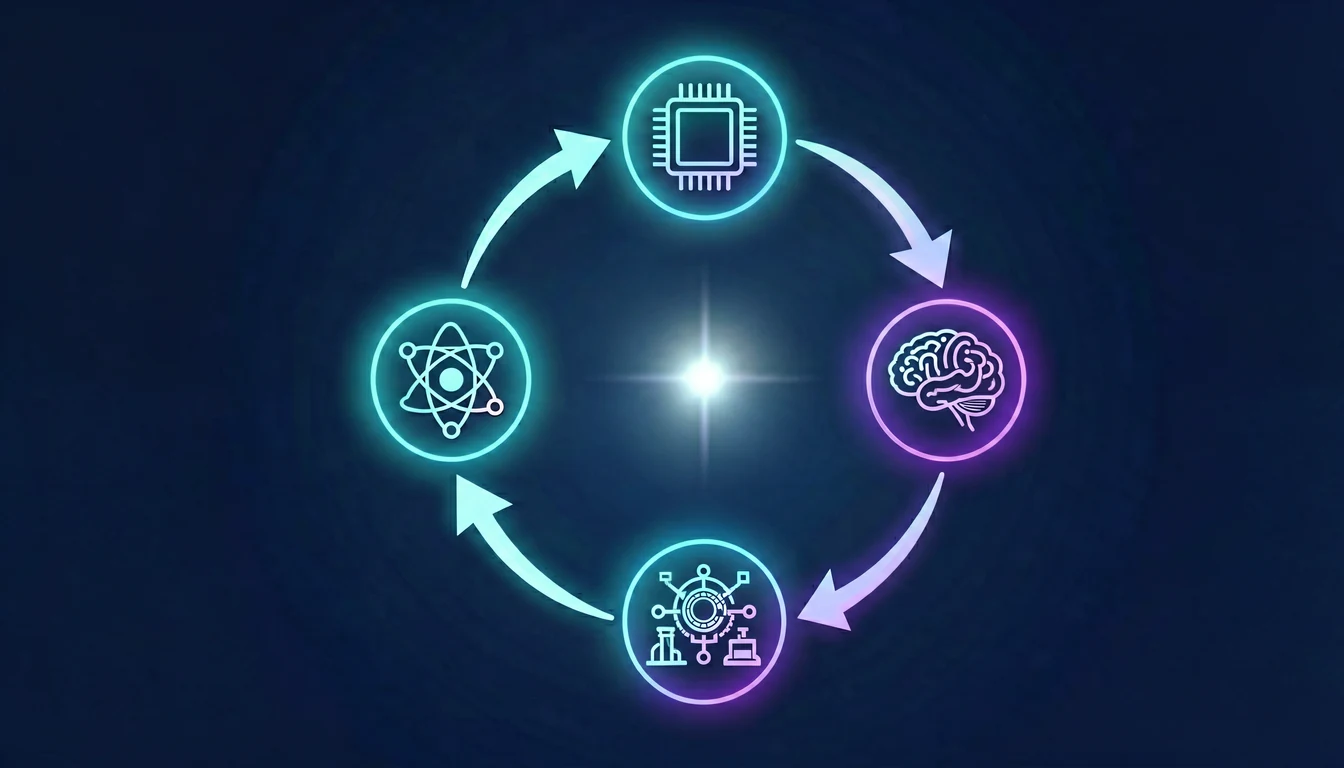
- The trilogy of carriers closes into a self-reinforcing loop: GPUs train AI, AI designs GPUs and QPUs, QPUs produce new knowledge, knowledge trains the next AI. The loop avoids model collapse because quantum injects diversity from outside the archive — from physical law.
Signal of the week: July 30, 2026
On Thursday, July 30, 2026, IBM together with the startup Algorithmiq and researchers from the University of Chicago presented a verified quantum advantage: a quantum computer solved a certain class of problems more efficiently than leading classical systems, and the result was checked. On the same day, in a CNBC interview, CEO Arvind Krishna spoke of a "trillion dollars of value" by the end of the 2030s — against the backdrop of IBM's stock falling 25% on July 14, the worst drop in the company's history. The press glued these two tempos together into headlines about speed and money.
But the true meaning of the event is different: for the first time in history, a machine produced verified physical knowledge that did not exist in any archive. To understand why this matters more than any benchmark, we must start not with quantum but with those who critically need this knowledge — with generative AI.
Data Wall: the archive is exhausted
Generative AI lives on the archive. LLMs sample the text accumulated by the human internet — and by 2026 this corpus is largely exhausted: labeled, chewed over, and synthetic text generated by other models leads to degradation — model collapse, the degeneration of the distribution in which a loop trained on its own outputs loses tails and anomalies. The industry calls this the Data Wall.
The question of the year: where to get knowledge that is not a retelling of the past? There are two answers. The first is to scale up empirical experiments: expensive, slow, limited by the throughput of laboratories. The second is to learn to compute knowledge from first principles, from the equations of physics. The second path is the quantum one.
Why quantum can produce knowledge that never existed
A molecule is a quantum system. To model it classically, an exponential number of states is required: describing N interacting electrons requires 2N classical bits — for a hundred electrons that is more than the number of atoms in the visible universe. Quantum solves the problem on its native carrier: the processor does not read nature from outside but emulates the evolution of the Hamiltonian e−iHt — it becomes the very physical system it simulates.
Hence a terminological precision worth remembering. AlphaFold is interpolation of the archive (data-driven): it looks for patterns in already known proteins. Quantum is calculation from first principles (ab initio): physical equations are solved without regard to previous empirical experience, allowing structures that never existed in nature to be modeled.
Here too is a contrast rarely written about. In LLMs noise is useful: temperature and randomness create variability and "creativity". In quantum computing noise is catastrophic: decoherence destroys phase coherence, turning the calculation into thermal noise. Classical AI works in the probabilistic gray zone of the archive; quantum demands absolute precision of the physical phase.
The first three clients
It follows who the first clients of quantum are: domains where the source of truth was never the archive — only nature.
Batteries. Simulation of electrolytes, anodes, cathodes. Classical methods cannot handle molecules of the required size; the potential is doubling energy density without trial and error in the laboratory.
Drugs. The Moderna + IBM case (2024): simulation of the secondary structure of mRNA up to 60 nucleotides on 80 qubits — purely quantum, without machine-learned models (No AI). The molecule's shape is calculated from physical laws, not extracted from the archive of known proteins.
Fusion. ITER, Commonwealth Fusion Systems: plasma, first-wall materials, superconductors. A domain where quantum gives a result that classical methods physically cannot.
What happened in 2026: from words to verified knowledge
Hardware
IBM Nighthawk — a 120-qubit processor presented on November 12, 2025 at the Quantum Developer Conference: 218 new tunable couplers in a square lattice, about 30% circuit-complexity gain over the Heron family. Roadmap: Kookaburra (2026) → Starling (2029), with a goal of 200 logical qubits and 100 million gates. In parallel — Loon, an experimental chip for testing fault-tolerance components.
Google Willow — 105 superconducting transmon qubits, announced December 9, 2024 in Nature; the Quantum Echoes algorithm gave a verified advantage on an abstract task. In October 2025, Willow interpreted nuclear magnetic resonance (NMR) data, reconstructing the 3D geometry of complex molecules — this is already quantum utility: a real physical task where classical NMR interpreters hit exponential complexity.
It is important not to confuse three terms the press constantly mixes up:
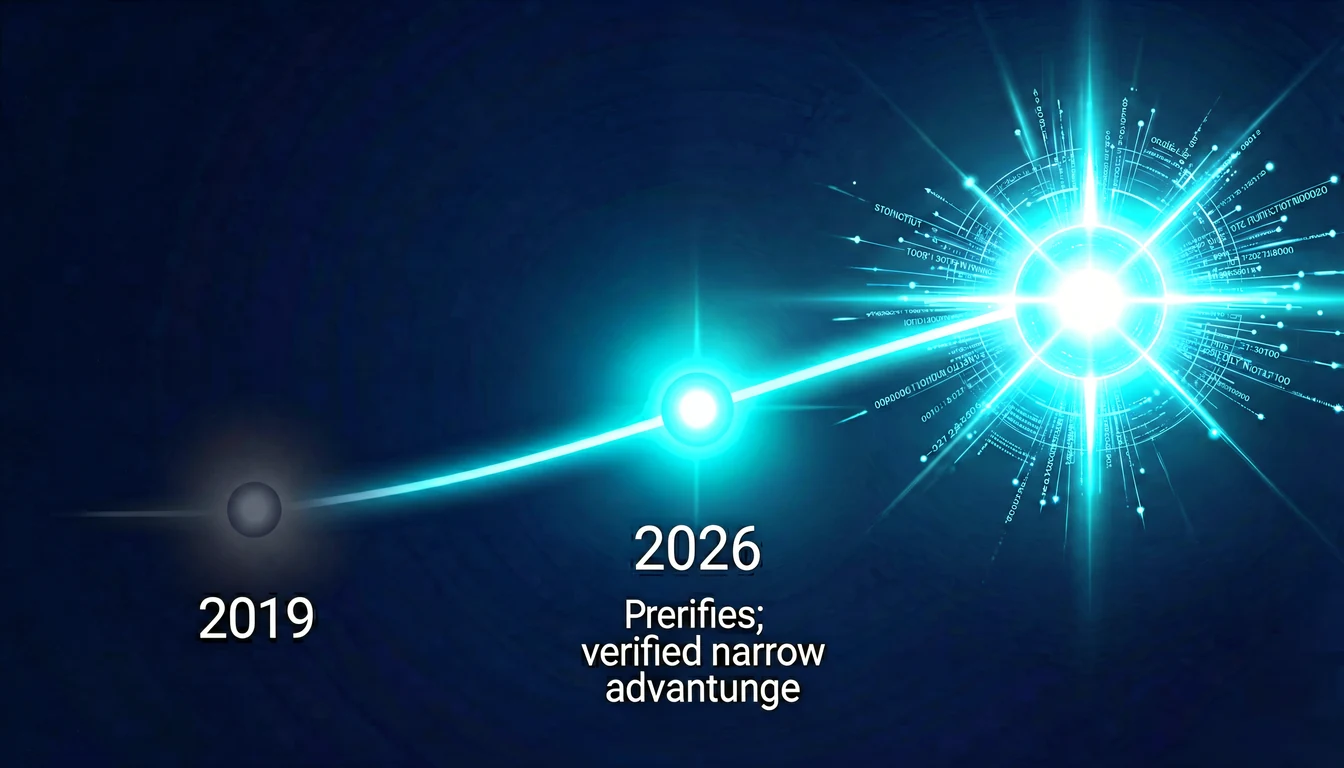
- Quantum supremacy (Sycamore, 2019) — superiority on a toy task, without practical value.
- Quantum advantage (IBM + Algorithmiq, 2026) — an advantage on a narrow useful task with verification of the result.
- Quantum utility — usefulness in production, when quantum gives a result classical methods physically cannot.
The hybrid loop: HPC + GPU + QPU
The quantum processor in 2026 does not work in a vacuum. The real breakthrough is hybrid orchestration: classical supercomputers and GPUs perform preliminary screening (filtering millions of candidate molecules), and the QPU connects only at the heaviest physical stage — the precise calculation of the ground state energy and electronic correlations, where classical methods hit a wall.
The Cleveland Clinic + RIKEN + IBM case (May 5, 2026) is direct proof: simulation of a protein of 12,635 atoms (T4-Lysozyme and Trypsin) on 94 qubits using 2 quantum processors and 2 supercomputers. Classical computing performs coarse splitting and branch pruning; the QPU solves only local quantum-mechanical electron interactions. Result: 40x growth in system size and 210x improvement in accuracy over previous benchmarks.
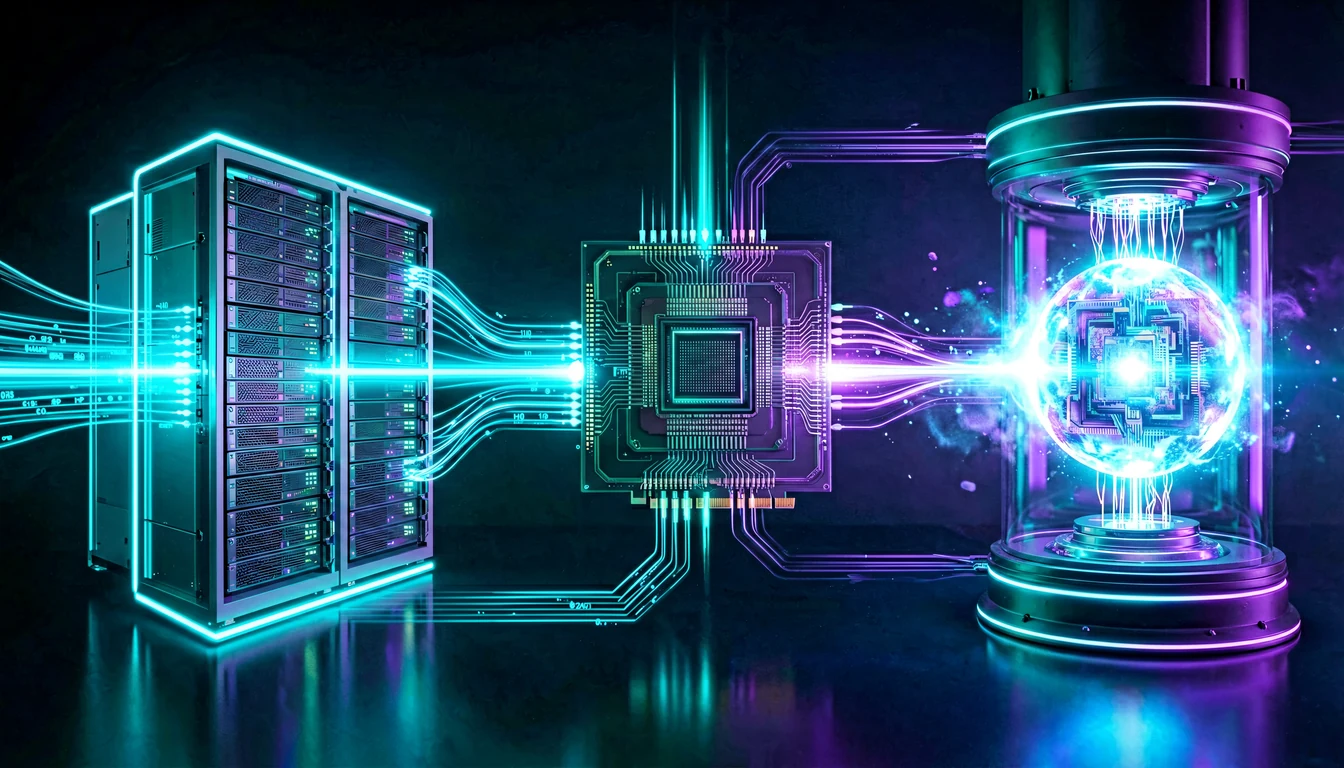
Quantum does not replace supercomputers. It works as a narrowly specialized accelerator of physical laws — a Physical Co-processor.
Verification: the main objection is closed
On July 30, 2026 IBM closed the main objection of critics — the verification problem. Three independent works — Algorithmiq (heterogeneous quantum materials, ~15 minutes of direct quantum time versus weeks of classical calculations with probabilistic assumptions), Qedma + RIKEN + BlueQubit, and UChicago — demonstrated advantage with built-in checking. The UChicago work is dedicated to Trusted Quantum Computation: mathematical criteria proving that a QPU result is a real physical state, not thermal noise, and allowing a client to verify cloud execution without a full classical recomputation.
In parallel, the open Quantum Advantage Tracker operates (launched in November 2025 together with Algorithmiq, the Flatiron Institute and BlueQubit) — a systematic check of claimed demonstrations. Independent verification instead of bare press releases.
Why a qubit cannot be "read": projection and the no-cloning theorem
Here it is worth pausing on a question almost nobody explains, although it defines the boundaries of quantum computing. Why is it impossible to simply "read" the state of qubits, as you read RAM?
Superposition exists inside the computation: 2N amplitudes coexist, and that is exactly the computing power of the register. But reading is a physical interaction, and by the laws of quantum mechanics measurement projects the superposition onto one of the basis states: in a single shot you get one classical bitstring, and the rest of the superposition is irreversibly destroyed. Copying the state in advance is also impossible — this is forbidden by the no-cloning theorem: an unknown quantum state has no copy.
The consequence: the 2N "knowledge" living inside the QPU cannot in principle be extracted whole. Only statistical samples are extracted — thousands and millions of shots, quantum tomography, whose number of measurements grows exponentially with the number of qubits. This is not an engineering flaw but a physical law. Therefore quantum is not a warehouse of huge data and not a universal computer for everything; it is an instrument for answering a correctly posed question. Superposition is the space of computation; projection is the form of the answer.
Diversity is inside; the bottleneck is at the output.
A new archive: Synthetic Physics Data
Now the chain closes. LLMs hit the Data Wall — they need a new source of knowledge. Quantum is for the first time able to produce knowledge that never existed: electron configurations, thermodynamic properties of alloys, protein-folding profiles, plasma phase transitions — computed from first principles. From this a new archive emerges — Synthetic Physics Data: a stratum of information that never existed in digitized form.
And this archive will become the dataset of future AIs. Tomorrow's specialized neural networks — Physics-Informed Neural Networks — will be trained not on Wikipedia texts and not on the synthetic text of other LLMs, but on quantum-modeled fundamental properties of matter. Quantum does not compete with neural networks — it supplies them with raw material.
Quantum does not only read nature. It begins to write a new archive for machines.
Risks: why the race of promises is more dangerous than quantum itself
Marketing dilution. The Krishna case: a technical milestone (Algorithmiq) and financial hype (a trillion amid the July 14 crash) run at different tempos; the press glues them into "IBM announced a move to a trillion-dollar valuation". That is not so — it is reassurance rhetoric laid over a real result. The same dilution trick as in "agentic AI".
Error correction is nonlinear. According to Gidney and Ekerå's estimate (2021), running Shor's algorithm on RSA-2048 requires about 20 million physical qubits; the best deployed IBM hardware has 120–156. A gap of 5+ orders of magnitude: the next order of precision demands an order of magnitude more qubits.
Classical methods do not stand still — tensor networks. Tensor Networks / MPS / PEPS allow classical GPUs to simulate medium-strength entanglement; in 2024–2026 supercomputers regularly "take back" supremacy from chips. Even Willow's demonstrations face skepticism in Nature (October 2025): hybrid GPU algorithms give comparable accuracy on small and medium molecules. Quantum supremacy is not a static line but a moving target.
Software stack. Without a mature stack even ideal hardware remains a laboratory: compilers, operation maps, debugging are only emerging. The GPU victory was won not by the transistor but by the software ecosystem.
The trilogy of compute carriers
Putting the picture together with the optical diptych, we get a division of labor between three physical carriers in 2026:
| Carrier | Physical principle | Main role in the AI stack | Limitation (Wall) |
|---|---|---|---|
| Silicon (GPU/HPC) | Electron movement in semiconductors | Archive storage, orchestration logic, classical inference | Energy barrier and heat density |
| Photon (Photonic TPU) | Light propagation in waveguides | Instant matrix multiplication, heat-free communication | No addressable memory (Memory Wall) |
| Qubit (QPU) | Superposition and entanglement | Emulation of physical laws (ab initio), generation of the synthetic archive | Decoherence and nonlinear error correction (Fidelity Wall) |
The closed loop: self-reinforcement of the computing civilization
The trilogy of carriers is a static picture: three physics, three roles, three walls. But if we look not at technologies but at processes, another level appears. Not three technologies — three mutually accelerating processes forming a closed loop.
GPUs train AI. AI — already today — designs better GPUs and QPUs: optimizes chip topologies, discovers materials and error-correction codes, calibrates quantum processors. QPUs create new physical knowledge — Synthetic Physics Data. New knowledge trains the next AI — not on rehashed text but on data about matter obtained from first principles. The loop closes and begins to accelerate itself.
Here is an important link to our earlier optics. In "The Beast Without Prophecy" we described the entropic dead end of a loop trained on its own outputs: model collapse, the loss of distribution tails. The textual LLM→LLM loop is closed on the archive — and therefore degenerates. The computing loop is stable precisely because the QPU injects diversity outside the archive — from the physical law. The loop gains a new environment: not the unstructured human environment behind the Wall, but nature itself, read through the Hamiltonian. The truncation of the environment was the condition of the loop's survival; now the loop has learned to read a new environment.
But the loop has limits worth naming right away. Its period is measured in years: design → fab → deployment → new knowledge; physical bottlenecks — fabs, cryogenics, energy — set the loop's frequency. The loop is closed only for those who own the entire stack — GPU, AI and QPU; for renters it is an external pipeline, and the caste layer strengthens. And goal-setting still remains outside the loop: it accelerates the production of knowledge but does not choose which knowledge to produce. Diversity by Ashby grows — but it is the diversity of law, not the diversity of goals.
The loop escapes collapse by connecting not to the human environment but to nature.
Conclusion: the caste scale
The quantum revolution of 2026 leads to an existential choice. In the era of classical AI, the gap between countries and companies was determined by the number of available GPU clusters. In the quantum era the gap becomes caste-like.
Those who own a physical QPU stack and hybrid supercomputers gain the ability to create new materials, pharmacology and energy systems directly from the equations of physics — and close the self-reinforcing loop on themselves. Everyone else will rent cloud quantum minutes, sending their molecular formulas to foreign infrastructure through Trusted Computation protocols.
Nature does not read the archive — it obeys physical law. And those who have learned to emulate this law on a quantum carrier define the technological landscape of the next thirty years. For the first time the loop produces the environment it trains on — and for the first time the question of who owns this cycle becomes more important than the question of how fast it spins.